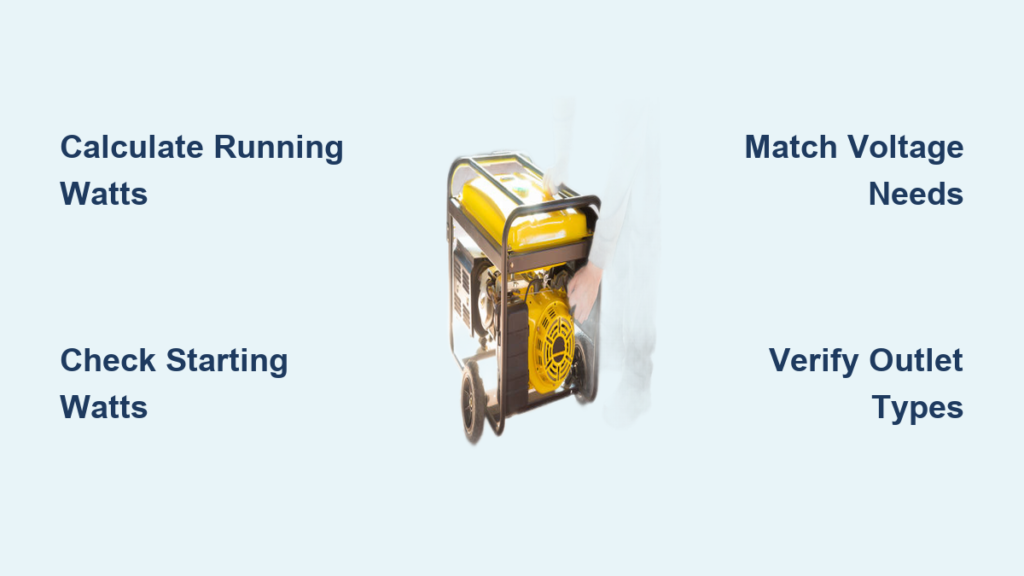
You’ve probably experienced the frustration of buying the wrong size generator—either one that constantly trips off when you try to run your air conditioner or an oversized model that guzzles fuel while sitting mostly idle. Since retailers won’t take back generators once you’ve added oil or fuel due to hazardous material restrictions, getting your portable generator size right the first time saves money and prevents headaches when you need power most. This guide reveals the exact sizing method professionals use to match generators to your specific needs, avoiding the two most common mistakes: undersizing that causes overload shutdowns or oversizing that wastes hundreds on unnecessary capacity and fuel.
Calculate Your Simultaneous Power Requirements

Identify Real-World Device Combinations
Before comparing generator models, list every appliance you’ll actually power at the same time—not everything you own. This critical step prevents overspending by eliminating loads that never run concurrently. Ask yourself practical questions: Will your microwave and air conditioner both run during dinner prep? Can you skip the coffee maker while using power tools? Does your RV water heater switch to propane when generator power is available?
Document each device’s voltage requirements—120V for most household appliances versus 240V for well pumps or larger air conditioners. This immediately eliminates incompatible generator models from your search. For RV applications, confirm you need 30-amp or 50-amp service, as this determines outlet types and sizing requirements.
Decode Running vs. Starting Watts Accurately
Every motor-driven device shows two power numbers that trip up most buyers. Your refrigerator might use 400 watts continuously but require 1,200 watts for the 2-3 seconds it takes the compressor to start. This surge requirement is why focusing only on running watts leads to constant overload shutdowns.
Find these specifications in three places:
– Appliance nameplates (look for “LRA” or “starting amps”)
– Manufacturer websites under technical specifications
– Owner manuals in the electrical data section
Think of it like pushing a bicycle: starting from a dead stop requires significant effort, but maintaining speed takes much less energy. Similarly, motors need that initial power surge to reach operating speed before settling into lower running requirements.
Perform the Critical Wattage Calculation
Running total: Add continuous watts for all simultaneous loads
Starting requirement: Add largest motor’s starting watts + running watts of everything else
This method accounts for real-world usage—appliances rarely start simultaneously. For example, if your 13,500 BTU RV air conditioner needs 2,800 starting watts while everything else runs at 1,150 watts, your generator must deliver 3,950 peak watts despite a running load of only 2,950 watts.
Size Generators for RV Power Needs Correctly

Apply Real Load Analysis to Your Trailer
Let’s size a generator for a 21-foot travel trailer with 30-amp service that requires propane fuel capability. Smart load elimination through scheduling removes unnecessary capacity requirements:
Non-electrical loads:
– Propane furnace (uses trailer battery for fan)
– Water heater (switches to propane mode)
– Microwave (used sparingly, not with A/C)
Actual electrical loads:
| Device | Running Watts | Starting Watts |
|---|---|---|
| 13.5k BTU A/C | 1,800 | 2,800 |
| Refrigerator | 400 | 1,200 |
| Coffee maker | 600 | 600 |
| 40″ LED TV | 70 | 70 |
| LED lights | 60 | 60 |
| Phone chargers | 20 | 20 |
Calculation results:
– Total running: 2,950 watts
– Starting requirement: 3,950 watts (A/C starting 2,800W + other running loads 1,150W)
Select the Right Propane Generator Model
Two propane-compatible generators meet these exact requirements:
Cummins P4500iDF
– 4,050 peak watts (exactly meets 3,950W requirement)
– 3,300 running watts (covers 2,950W load)
– Built-in 30A RV outlet
– Propane/dual fuel capability
Cummins P5000iDF EFI
– 4,500 peak watts (extra 500W buffer)
– 3,500 running watts
– Electronic fuel injection for smoother operation
– Higher price for minimal additional capacity
Both exceed calculated needs while avoiding the 5,000+ watt models that add unnecessary weight and cost.
Avoid Costly Sizing Mistakes That Trap Beginners
Motor Starting Reality Check
That 3,500-watt generator won’t start your 15,000 BTU RV air conditioner rated at 3,500 running watts. The starting surge typically adds 1,000-1,500 watts, requiring 4,500-5,000 peak watts minimum. Always verify starting requirements first—this single step prevents 80% of generator sizing errors.
Future-Proofing Trap
Buying “extra capacity for later” often means hauling 30% more weight and burning extra fuel daily. Size for current needs, then reassess if you add major loads like a second air conditioner or electric water heater. Most RV owners never need more than 4,500 peak watts for standard setups.
Voltage Compatibility Issues
A 120V-only generator can’t power 240V well pumps or electric dryers. Verify your largest loads’ voltage requirements before final selection. Most RV setups use 120V exclusively, while home backup systems often need 240V capability for well pumps or HVAC systems.
Match Generator to Propane or Gasoline Fuel Type
Propane Advantages for RV Applications
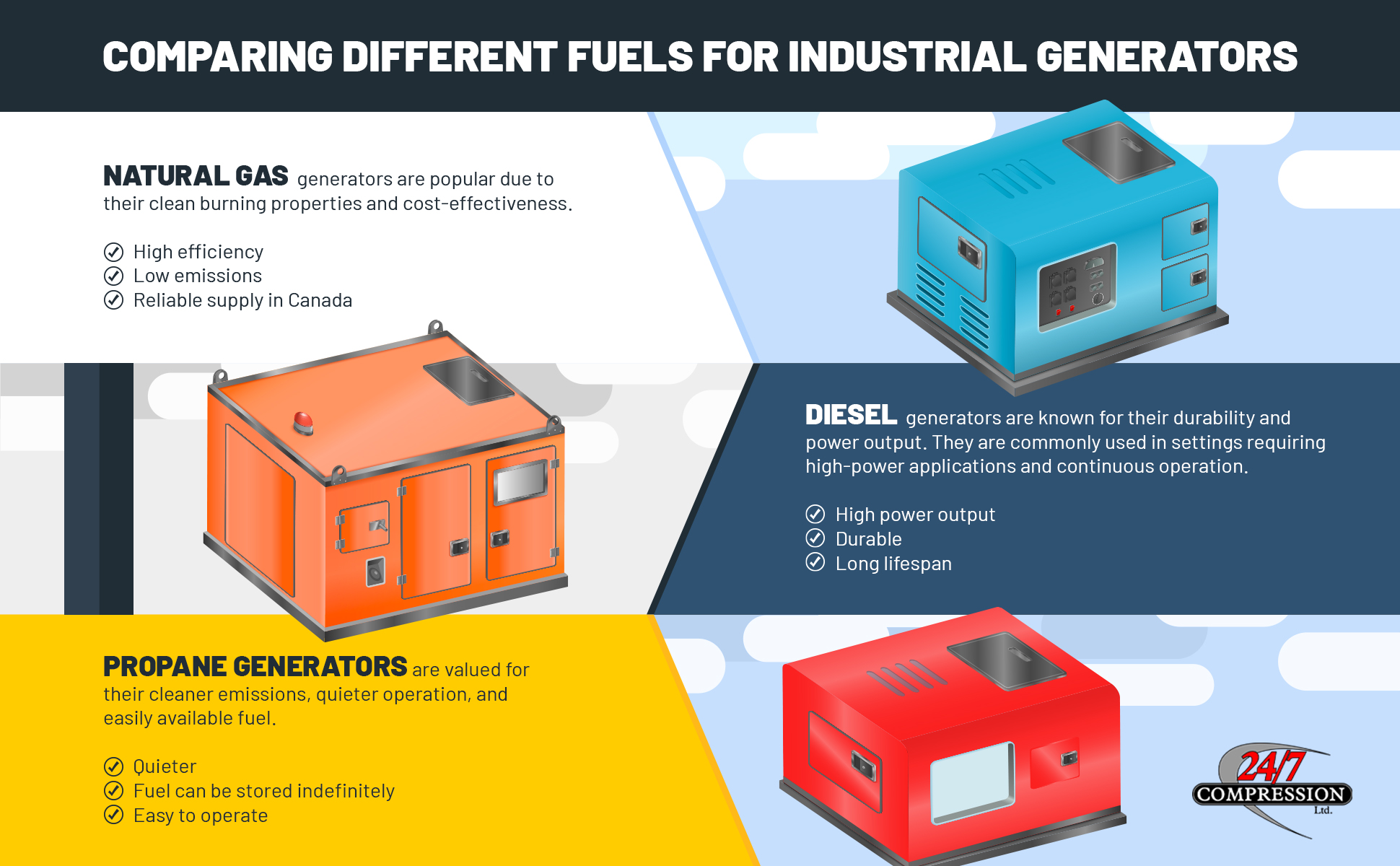
Propane generators solve multiple camping challenges: no gasoline storage issues, stable fuel during long storage periods, and compatibility with existing RV propane systems. The slight power reduction (10-15% lower output on propane versus gasoline) typically falls within acceptable margins for RV applications.
Fuel choice impacts your generator in four critical ways:
– Power output (propane reduces peak watts 10-15%)
– Storage requirements and safety concerns
– Maintenance intervals (propane burns cleaner)
– Long-term fuel stability (propane doesn’t degrade)
Gasoline Considerations for Home Backup
Gasoline models offer maximum power output and often cost less initially. However, fuel stabilizer becomes mandatory for seasonal use, and gasoline storage creates fire safety concerns in enclosed spaces. For home backup where you’ll use the generator infrequently, propane’s stability makes it worth the slight power reduction.
Verify Essential Connection Types Before Purchase
RV-Specific Power Outlets
Look for these factory-installed connections on RV generators:
TT-30 outlet: 30-amp, 120V for direct RV shore power connection
L5-30 outlet: 30-amp, 120V twist-lock for weatherproof connections
Standard 20A outlets: Household plugs for general use
Warning: Adapters can cause voltage drop issues and safety hazards—match generator outlets directly to your connection method whenever possible.
Home Backup Transfer Switch Compatibility
L14-30 outlet: 30-amp, 120/240V for manual transfer switch connection
14-50 outlet: 50-amp, 120/240V for larger home systems
Size your generator for transfer switch capacity, not total home load. A 30-amp transfer switch (7,200 watts) typically covers essential circuits effectively without overspending.
Plan for Maintenance and Long-Term Reliability
Optimize Load Management for Engine Longevity
Properly sized generators run at 50-75% load during normal operation—the sweet spot for engine longevity and fuel efficiency. Oversized units constantly run at low loads, causing carbon buildup and wet stacking issues that lead to premature failure.
Calculate Runtime for Expected Outage Duration
Match fuel tank size to your typical outage duration. A 3,500-watt generator running at 50% load consumes approximately 0.3 gallons per hour on gasoline. Plan for 8-12 hour runtime minimum to avoid dangerous middle-of-the-night refueling.
Fuel consumption reference:
– 3,000 watts at 50% load: 0.25 gal/hour
– 5,000 watts at 50% load: 0.4 gal/hour
– 7,000 watts at 50% load: 0.6 gal/hour
Final Generator Selection Checklist Before Purchase
Before finalizing your purchase, verify these specifications exceed your calculations:
□ Peak/surge watts > calculated starting requirement
□ Running watts > calculated continuous load
□ Correct voltage (120V, 240V, or 120/240V)
□ Matching outlet types for your connection method
□ Acceptable weight for your mobility needs
□ Fuel type compatibility with your storage capabilities
Take your load calculations shopping and compare specifications directly. The right generator balances your power needs, budget, and practical constraints without oversizing “just in case.” Remember: once you add fuel, that generator becomes yours permanently. Getting the sizing right the first time prevents costly mistakes and ensures reliable power exactly when you need it most.