
Your generator’s engine hums steadily, but every outlet remains lifeless. Lights stay dark, refrigerators go silent, and critical devices won’t power on—despite the machine running perfectly. This “engine runs, no power” nightmare hits thousands of portable generator owners annually, especially during blackouts or camping trips. Here’s the critical truth: 90% of these failures stem from one fixable issue—lost residual magnetism in the rotor. The good news? You can restore power in under 15 minutes using tools you likely already own, avoiding costly service calls and getting your electricity back now.
This guide delivers exact diagnostic steps and field-proven repair methods trusted by technicians. Forget vague advice—you’ll learn precisely why your generator died, how to confirm the cause, and two reliable fixes (including a battery-free method). We’ll also cover critical safety traps and foolproof prevention to ensure this never happens again when you need power most.
Why Your Generator Runs But Produces Zero Electricity
The Magnetic Memory Breakdown
Portable generators don’t use permanent magnets—they rely on residual magnetism: a microscopic magnetic “imprint” left in the rotor’s iron core after shutdown. This faint field kickstarts voltage production when you start the engine. Without it, the generator becomes a noisy paperweight. When residual magnetism vanishes, your engine spins freely but can’t generate electricity—like trying to start a fire with damp tinder.
Common triggers that erase this magnetic memory:
– Storage longer than 3 months (the #1 cause for seasonal users)
– Shutting down under heavy load (e.g., turning off mid-refrigerator cycle)
– Running completely unloaded for hours (common during standby testing)
– Electrical shorts from faulty appliances or extension cords
– Natural decay from heat cycles and aging components
5 Critical Checks Before Fixing Your Dead Generator
Don’t jump straight to repairs—ruling out simpler issues saves wasted effort. Perform these checks in order:
- Verify engine speed: Your multimeter must read 60 Hz (or 50 Hz for international models). Below 58 Hz indicates slow RPM—adjust the governor before proceeding.
- Test every outlet: Measure AC voltage at all receptacles. True “no power” means 0V everywhere—not just one dead outlet.
- Reset breakers and GFCI: Push the GFCI “TEST” button fully, then “RESET.” Many users miss this tiny button beside outlets.
- Inspect brush block connections: Locate the carbon brush housing (typically under a panel near the engine). Ensure wires aren’t loose or burnt.
- Disconnect ALL loads: Unplug every device, including extension cords. Retest with nothing attached.
If voltage still reads 0V after these steps, your generator has lost residual magnetism. Proceed immediately to field flashing—the only fix.
Field Flashing: Two Ways to Restore Your Generator’s Power
Battery Method: 12V Fix That Works Every Time
What you need: Car battery, two insulated jumper wires, safety glasses (non-negotiable—sparks will fly).
Follow these steps precisely:
1. Stop the engine completely—no exceptions.
2. Find the voltage regulator (AVR): A small black box (3-4″ square) near the brush block. Unplug its two spade connectors (usually red/black or red/white wires).
3. Connect ground wire: Attach the black/white brush lead to the battery’s negative terminal.
4. Start and stabilize: Crank the engine and let it reach full speed (3600 RPM).
5. FLASH: Momentarily (3 seconds MAX) touch the red brush lead to the battery’s positive terminal. You’ll hear a distinct clunk from the AVR.
6. Shut down and reconnect: Turn off the generator, reattach both wires to the AVR.
Restart and test: Voltage should now read 120V. If not, repeat once—never flash longer than 3 seconds to prevent rotor burnout.
Critical safety warnings:
– ⚠️ NEVER let brush leads touch the generator frame during flashing—this causes catastrophic short circuits.
– ⚠️ ALWAYS wear eye protection—battery arcing can eject molten metal.
– ⚠️ DISCONNECT IMMEDIATELY after flashing—prolonged contact overheats the rotor.
No-Battery Drill Method: Fix It With Tools You Have On-Site
Why this works: Your corded drill’s motor contains permanent magnets. When you spin its chuck backward, it acts as a mini-generator, injecting current into your dead generator’s stator.
Step-by-step rescue:
1. Plug a corded drill (½” chuck size) into any 120V outlet.
2. Set the drill’s direction switch to FORWARD (clockwise rotation).
3. Start the generator engine.
4. Fully depress the drill trigger while gripping the tool firmly.
5. Rapidly spin the chuck COUNTER-CLOCKWISE with your free hand (gloves recommended).
6. Watch for engagement: Within 1-3 seconds, the drill motor will suddenly whir to life under its own power—confirming restored magnetism.
Pro tip: If the drill spins backward, flip its direction switch and repeat. Works 95% of the time for generators under 6kW. No battery? No problem—you’re back in business before help arrives.
When Field Flashing Fails: Advanced Fixes
If flashing doesn’t restore power, deeper issues exist. Stop and assess these critical failures:
Faulty Voltage Regulator (AVR) Symptoms
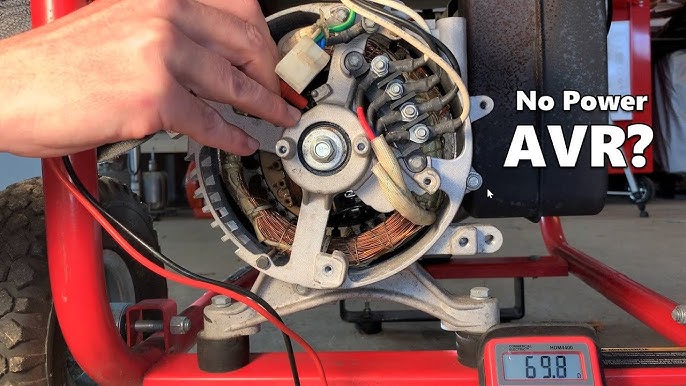
– Voltage spikes then collapses within seconds
– Burnt smell near the AVR box
– Test: Disconnect brush wires and apply 12V directly to rotor slip rings. If voltage jumps to 150-180V, replace the AVR (match your model number exactly).
Worn Carbon Brushes: The Silent Killer

– Check: Remove brushes from holders—they must be longer than 6mm (¼ inch). Shorter = replace immediately.
– Inspect slip rings: They should be mirror-bright copper. Scuffed or blackened rings need polishing with 600-grit sandpaper.
– Test resistance: Place multimeter probes on brush holder terminals. Reading over 0.1Ω means poor contact—clean or replace.
Open Stator Windings: The Death Knell
- Measure resistance between stator leads (hot/neutral wires):
- ✅ Normal: 0.3–0.8Ω (like a short copper wire)
- ❌ Failure: Infinite resistance (open circuit) or 0Ω (short)
- Reality check: Rewinding stators costs 70% of a new generator—replacement is usually smarter.
Prevent Your Generator From Dying Mid-Crisis
Monthly Maintenance That Takes 15 Minutes
- Run under load: Every 30 days, power a space heater or hairdryer (25-50% capacity) for 15 minutes.
- Shutdown correctly: Always turn OFF appliances before stopping the engine—never kill switch under load.
- Storage protocol: For >6 months storage, flash the field before first use (yes, even if “just stored”).
- Fuel rule: Add stabilizer to gas before filling the tank—stale fuel causes hard starts that collapse magnetic fields.
Emergency Storage Checklist
- Run generator with medium load for 15 minutes
- Turn off all appliances
- Let engine idle 2 minutes
- Shut down cleanly (no load)
- Store in dry place with fuel stabilizer
Non-Negotiable Safety Rules
Life-Saving Warnings You Must Follow
- NEVER operate indoors—carbon monoxide kills silently in under 5 minutes. Use battery-operated CO detectors.
- ALWAYS disconnect loads before flashing—stray voltage can fry appliances.
- COOL DOWN FIRST—wait 20 minutes after shutdown before accessing brush blocks (hot surfaces cause severe burns).
- INSULATED TOOLS ONLY—no metal jewelry near electrical components.
When to Call Professionals
Contact Generac support (1-800-800-5345) or a certified technician if:
– Field flashing fails twice
– You smell burnt insulation
– Voltage is unstable after repair
– Your model is under warranty
Bottom line: When your portable generator runs but delivers no power, lost residual magnetism is almost always the culprit. Battery flashing or the drill method will restore electricity 90% of the time—faster than waiting for service. Make monthly 15-minute load runs part of your routine to prevent this failure entirely. Remember: A well-maintained generator is your lifeline during outages. Act now, and never face darkness when the grid fails again.


