Arriving at a remote campsite only to discover your “quiet” generator drowns out birdsong—or your battery bank dies before the coffee finishes brewing—ruins the moment fast. The right power source transforms a patch of forest into a comfortable base without sacrificing the outdoor experience you came for. This guide cuts through the confusion of how to choose a generator for camping by giving you exact wattage math, noise thresholds to avoid park violations, and model-specific recommendations for every camping style. You’ll learn to match capacity to your actual gear load—not marketing hype—so your generator delivers reliable power while respecting nature’s soundtrack.
Camping Generator Types Compared

Why Battery Power Stations Win for Most Campers
Battery units like the BLUETTI EB3A store electricity in lithium cells and deliver silent, zero-emission power through standard outlets and USB ports. They weigh as little as 4.6 kg, making them backpack-friendly for minimalist trips. Since they produce no fumes, you can safely run them inside tents to power CPAP machines or charge phones overnight. The trade-off? Finite capacity: a 268 Wh battery might last 6 hours for LED lights and phone charging but only 1 hour for an electric stove. Recharge requires wall sockets, car ports, or solar panels—so plan your sun exposure if off-grid. Choose these when silence, safety, and low maintenance outweigh raw power needs.
Solar Generators: Sun-Powered Freedom for Extended Stays
A solar generator pairs a battery station (like the BLUETTI AC180) with portable photovoltaic panels. Sunlight refills the battery during the day, letting you run lights or fridges after dark. With 400–500 W of panels, you’ll fully recharge a 1,152 Wh battery in 3–6 hours of direct sun—ideal for sunny climates or weeklong base camps. Critical warning: Cloudy days slash panel output by 50–80%, so always pack extra capacity. These systems shine when hauling fuel is impractical, but they’re useless during multi-day storms. Skip them if you camp primarily in dense forests or rainy seasons where sunlight is unreliable.
When Gasoline Generators Are Worth the Noise
Small inverter-style gasoline units (like the Honda EU3000is) deliver 1,000–4,000 W of continuous power and refuel in minutes from any gas station. They’re the only option for running high-draw gear like induction cooktops or power tools at remote job sites. But expect 65–85 dB of noise—comparable to a vacuum cleaner—and toxic exhaust requiring 20+ feet of clearance from tents. Budget for ongoing costs: fuel stabilizer ($10), oil changes every 50–100 hours ($20), and spark-plug replacements ($15). Only choose gasoline if you need serious wattage for large groups and camp in areas without noise restrictions.
Why Diesel Generators Rarely Fit Camping Needs
Diesel models trade weight and noise for better fuel efficiency and engine longevity. While useful for month-long RV trips with frequent high-draw appliances, they’re overkill for 95% of campers. Expect 70+ dB noise, pungent exhaust, and 30+ kg weight—plus higher upfront costs ($1,500+). Most national parks ban diesel units entirely due to emissions. Unless you’re powering a mobile workshop in remote Alaska, skip diesel; modern battery stations or quiet gasoline inverters serve campers better.
Calculate Your Exact Wattage Needs
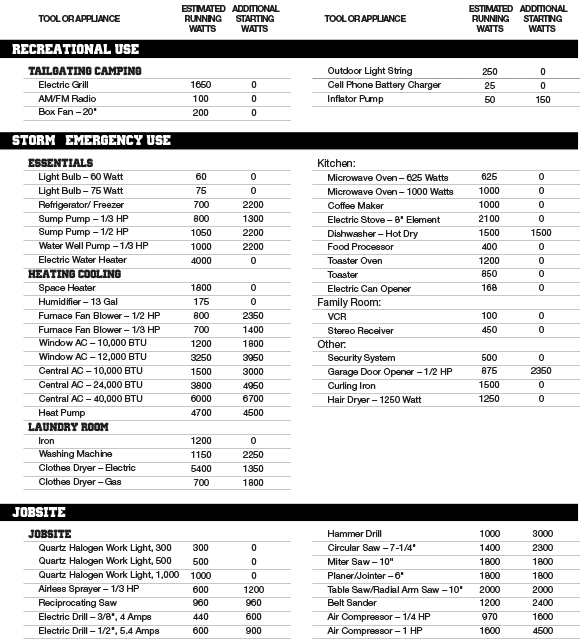
Avoid Underpowered Generators with This Wattage Inventory
List every device you’ll plug in, noting both continuous watts (steady power draw) and starting watts (surge on startup). Motors and compressors—like those in fridges or grills—need 1.5x their running wattage for 2–3 seconds when kicking on. Miss this, and your generator will shut down mid-coffee brew.
| Gear | Continuous | Starting |
|---|---|---|
| Portable fridge | 80 W | 120 W |
| Electric coffee maker | 800 W | 1,200 W |
| Phone charger | 20 W | — |
| LED lantern | 5 W | — |
| Electric grill | 1,500 W | 2,000 W |
Apply the 20% Safety Margin Formula
Add all continuous watts (e.g., 80 + 800 + 20 + 5 + 1,500 = 2,405 W), then multiply by 1.2 to cover inverter losses and hidden draws (2,405 × 1.2 = 2,886 W). Your generator must exceed this continuous rating. Then, identify your single largest starting surge (here, 2,000 W for the grill)—your unit’s peak rating must beat this. Pro tip: Run high-surge devices like grills one at a time to avoid overloading.
Match Size to Your Camping Style

Minimalist Backpackers: 500–1,000 W Units
Phones, headlamps, and a speaker rarely pull over 250 W. The BLUETTI EB3A (600 W continuous, 4.6 kg) fits this load and recharges via a 120 W solar panel in 3–4 hours of sun. Its whisper-quiet operation (<45 dB) won’t disturb dawn birdwatching. Skip if you’ll use anything with a motor—this unit stalls under fridge compressors.
Car Campers & Families: 1,000–2,000 W Sweet Spot
Add a fridge, coffee maker, and drone batteries, and 1,800 W continuous becomes essential. The BLUETTI AC180 handles this load for 6 hours on battery alone or indefinitely with 400–500 W of solar. At 16 kg with a built-in handle, it’s car-camping friendly. Avoid this mistake: Overloading by plugging in a microwave—most 1,000–2,000 W units can’t handle its 1,200 W starting surge.
RV or Base-Camp Crews: 2,000 W+ Systems
Running an induction cooktop, CPAP machine, and fridge overnight demands serious muscle. The BLUETTI AC200L delivers 2,400 W continuous (expandable to 8 kWh) while staying under 50 dB—quiet enough for campground quiet hours. Its 28 kg weight requires wheeled transport, but it powers medical devices safely indoors.
Critical Selection Criteria You Can’t Ignore
Noise Rules That Prevent Park Fines
Most national parks cap generator noise at 60 dB measured 7 meters away. Battery stations run at 45–50 dB (like a whisper), while gasoline units hit 53–58 dB in eco-mode. Always verify: A Honda EU2200is might claim “57 dB,” but that’s only at 25% load—idle noise often exceeds 60 dB. Test units in-store before buying.
Portability Thresholds That Match Your Vehicle
- Under 5 kg: Backpack carry (e.g., EB3A)
- 5–20 kg: Single-hand lift with handle (e.g., AC180)
- 20–35 kg: Requires wheels or two-person carry—measure your trunk space first!
Ignoring weight leads to abandoned generators: that “portable” 28 kg unit won’t fit in a compact SUV.
True Cost of Ownership Beyond Sticker Price
Battery stations cost $600–$1,200 for 1–2 kWh capacity but have near-zero maintenance. Gasoline units run $350–$900 per 1,000 W, yet fuel adds $50/month for weekend trips plus $50/year in oil/spark plugs. Over 5 years, a $900 Honda EU3000is costs $1,800 with fuel—versus a $1,100 BLUETTI AC180 with no recurring fees.
Maintenance Mistakes That Kill Generators Early
Battery Station Lifespan Hacks
- Store at 50–80% charge in temperatures between 10–30°C (50–86°F)
- Cycle to 100% every 3–4 months to prevent cell imbalance
- Update firmware via the brand’s app to optimize charging logic
Leaving batteries at 0% or 100% for months permanently reduces capacity.
Gasoline Generator Survival Rules
- Change oil every 50–100 hours (not annually!)
- Run the carburetor dry before storage to prevent gumming
- Transport fuel only in certified containers—never inside your cabin
Skipping oil changes causes 70% of premature gasoline generator failures.
Quick-Decision Matrix for Your Trip
| Scenario | Load Range | Tech Choice | Example Model |
|---|---|---|---|
| Backpacking | 100–250 W | Pocket battery | BLUETTI EB3A |
| Family tenting | 1–1.5 kW | Mid-size battery | BLUETTI AC180 |
| RV base camp | 2–3.5 kW | Expandable battery | BLUETTI AC200L |
| Job-site tools | 3–5 kW | Gasoline inverter | Honda EU3000is |
Final Pre-Purchase Checklist
- [ ] Added 20% to total continuous watts and verified peak surge capacity
- [ ] Measured vehicle storage space—confirmed unit fits with handles folded
- [ ] Checked campground noise limits (most require ≤60 dB)
- [ ] Calculated solar recharge time based on local peak-sun hours
- [ ] Compared 5-year costs: battery (unit only) vs. gasoline (unit + fuel + maintenance)
Choosing the right generator means never choosing between comfort and quiet again. By matching wattage to your actual gear, respecting noise boundaries, and calculating true costs, you’ll power your campsite without powering down the wilderness experience. Final pro tip: Test your setup at home first—run your full load for 30 minutes to catch surprises before you hit the trail. Now grab your gear, charge your batteries, and camp happy.