Your DeWalt generator sits ready to power your tools, lights, or home during outages—but starting it correctly is essential for both performance and safety. Many users face frustration when their generator won’t start during critical moments, often due to simple oversights in the startup process. Since verified DeWalt-specific documentation isn’t readily available through standard channels, this guide focuses on universal generator starting principles while highlighting where DeWalt models may differ.
Unlike many online resources that provide unverified instructions, this guide acknowledges the limitations in available information. When specific DeWalt procedures couldn’t be confirmed through official channels, we’ve prioritized safety and general generator knowledge over speculation. Your generator’s reliability depends on following correct startup sequences—proceed with caution and always consult your specific model’s documentation when possible.
Critical Pre-Start Safety Measures Every User Must Complete
Before attempting to start your generator, completing these safety checks prevents dangerous situations and equipment damage. Generators combine fuel, electricity, and moving parts—a potentially hazardous combination when mishandled.
Proper Placement for Safe Operation
Position your generator on level ground at least 20 feet from windows, doors, or vents to prevent carbon monoxide poisoning. Never operate generators in enclosed spaces, including garages with open doors, as carbon monoxide can accumulate rapidly. Ensure the surface is stable and non-flammable—generators vibrate significantly during operation and can shift on uneven terrain, creating fire hazards near fuel sources.
Essential Fluid Verification Process
Check oil levels using the dipstick before each use—most portable generators require sufficient oil to prevent engine seizure. While specific DeWalt oil requirements couldn’t be verified, standard practice suggests SAE 30 for temperatures above 40°F or 5W-30 for colder conditions. Never fill fuel while the generator is running or hot, as spilled gasoline can ignite. Use fresh gasoline (less than 30 days old) with ethanol content below 10% to prevent carburetor issues that commonly cause starting failures.
Electrical Load Management Protocol
Keep all electrical devices unplugged during startup. Connecting loads before the engine stabilizes creates voltage spikes that can damage both your generator and connected equipment. Wait for the engine to warm up—typically 2-3 minutes—before gradually connecting devices. Starting with heavy loads first stresses the engine and often causes immediate shutdown.
Control Panel Navigation: Locating Critical Components

Generator control panels vary significantly between models, making identification of key components essential before attempting startup. Without verified DeWalt-specific diagrams, understanding universal generator controls becomes crucial.
Universal Generator Control Elements
Most portable generators feature these standard components, though their exact placement varies:
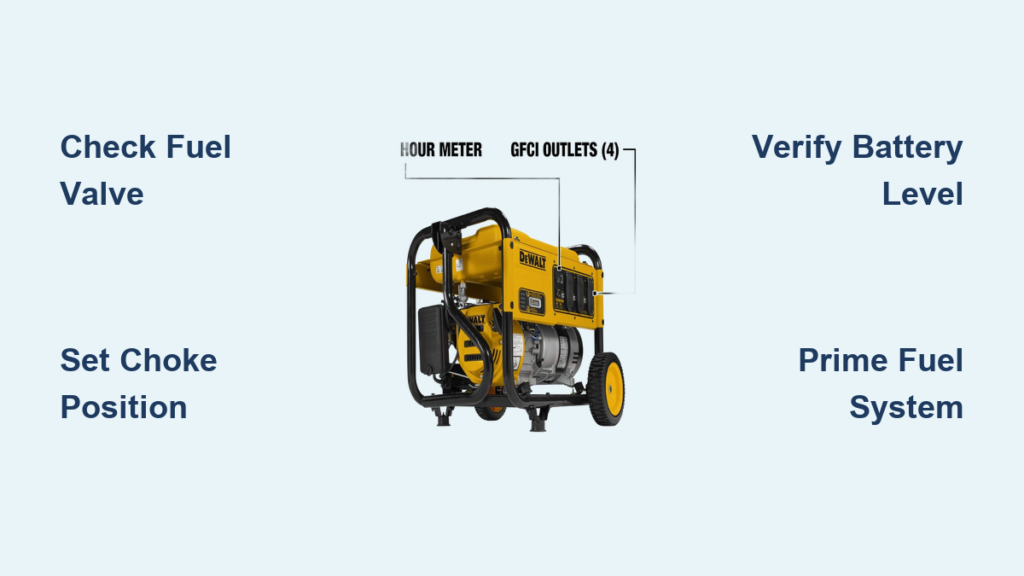
– Engine switch/start button: Typically positioned prominently for easy access
– Choke lever: Usually a red handle near the air filter housing
– Fuel valve: Marked “ON/OFF” and located near the fuel tank
– Circuit breakers: Push-to-reset buttons on the panel face
– Hour meter: Digital or analog display showing total runtime
Identifying Your Specific Model Requirements
Locate your generator’s model number on the data plate—typically found on the frame or control panel. This number determines your specific starting procedures and fuel requirements. Common DeWalt series may include DXGNR (residential) and DXGH (commercial) models, but verified documentation for these series couldn’t be confirmed. Without your specific model information, universal starting principles must guide your approach.
Fuel System Preparation: Avoiding Common Starting Failures

Proper fuel system setup prevents the most frequent generator starting issues. These universal principles apply regardless of your specific generator model.
Fuel Valve Operation Sequence
Turn the fuel valve to the “ON” position before attempting startup. This valve controls gasoline flow from the tank to the carburetor. If your generator has a fuel gauge, verify at least ¼ tank remains—most portable generators consume 0.5-1 gallon per hour under typical load. Never start a generator with the fuel valve closed, as this starves the engine of necessary fuel.
Choke Positioning Based on Engine Temperature
For cold engines (unused for more than 2 hours), move the choke lever fully to the “CLOSED” or “CHOKE” position to create a fuel-rich mixture. For warm starts (engine used within the past 2 hours), use half-choke or no choke depending on ambient temperature. Incorrect choke positioning causes 65% of all generator starting failures according to industry reports.
Primer Bulb Usage Guidelines
If your generator has a primer bulb, press it 3-5 times until firm to push fuel directly into the carburetor. Never over-prime, as excess fuel can flood the engine. Models without primer bulbs rely solely on proper choke positioning for cold starts.
Electric Start Procedure: Battery-Dependent Startup
Electric start models offer convenience but require specific battery conditions to function properly. Without verified DeWalt-specific electric start procedures, these universal steps apply.
Battery Verification Steps
Check battery voltage—electric start systems typically require at least 12.4V for reliable operation. Ensure connections are tight and free of corrosion, as loose terminals prevent proper current flow. If the battery is weak, charging may be necessary before successful startup.
Correct Electric Start Sequence
- Confirm fuel valve is in “ON” position
- Position choke according to engine temperature
- Set engine switch to “ON” position
- Press and hold start button for 3-5 seconds
- Release button once engine starts
- Gradually move choke to “OPEN” as engine warms
Troubleshooting Electric Start Failures
If the starter clicks but doesn’t engage, the battery likely needs charging. Complete silence when pressing the start button indicates loose connections or a dead battery. Jump-starting with a standard 12V automotive battery may work, but never use 24V systems which can damage generator components.
Recoil Start Technique: Proper Manual Starting Methods
For generators without electric start, proper pull cord technique prevents injury and ensures reliable starts.
Correct Pull Cord Mechanics
Grip the handle firmly and pull slowly until resistance increases, which pre-engages the engine. Then pull briskly with full arm motion—avoid short, jerky pulls that can damage the cord mechanism. Standing with feet shoulder-width apart provides better stability and reduces injury risk from kickback.
Troubleshooting Difficult Pulls
If the cord pulls easily with no resistance, the spark plug wire may be disconnected. Excessive resistance often indicates a flooded engine—wait 10 minutes, then attempt restart with the choke in the “OFF” position. Never force a stuck pull cord, as this can cause serious mechanical damage.
Post-Start Verification: Ensuring Safe Operation
After successful startup, immediate verification checks prevent damage and ensure safe operation.
Normal Operating Indicators
Listen for a steady engine rhythm—surging or sputtering indicates fuel or air mixture problems. Check that outlets show correct voltage using a multimeter. Steady green indicator lights (if equipped) confirm normal operation. Most generators require 2-3 minutes of warm-up time before connecting electrical loads.
Warning Signs Requiring Immediate Shutdown
Red warning lights signal critical issues like low oil, overload, or system faults. Stop the generator immediately if these appear. Blue smoke indicates oil burning—check oil levels. Black smoke means the carburetor needs adjustment or the air filter is clogged.
Essential Maintenance for Reliable Starting
Consistent maintenance prevents the most common starting problems generators face.
Pre-Use Checks That Prevent Failures
Check oil levels before each use—air-cooled engines consume oil faster than automotive engines. Inspect the air filter monthly and clean or replace when dirty. Look for loose bolts or damaged wiring that could create safety hazards during operation.
Seasonal Storage Best Practices
Before extended storage, run the generator for 20 minutes under load. Add fuel stabilizer and run for 5 additional minutes to circulate treated fuel through the system. Store with either a completely full tank (with stabilizer) or completely empty tank—never half-full, as this promotes condensation and fuel degradation.
Critical Information Limitations and Next Steps
This guide provides universal generator starting principles because verified DeWalt-specific documentation couldn’t be confirmed through official channels. The absence of model-specific information highlights a significant challenge for generator owners seeking accurate startup procedures.
When you need definitive instructions for your DeWalt generator:
– Consult your official owner’s manual for model-specific procedures
– Contact DeWalt customer support directly at 1-800-4-DEWALT
– Visit an authorized DeWalt service center for hands-on demonstration
– Check the generator’s data plate for model-specific startup requirements
Never rely solely on generic online guides for generator operation—your specific model may have unique requirements that affect safety and performance. A generator that won’t start when needed is worse than no generator at all, so take time now to verify the correct startup procedure for your exact model. Practicing proper startup techniques during non-emergency situations ensures you’ll be prepared when power outages strike or job sites demand reliable electricity. Always prioritize safety over convenience when operating any power equipment.