
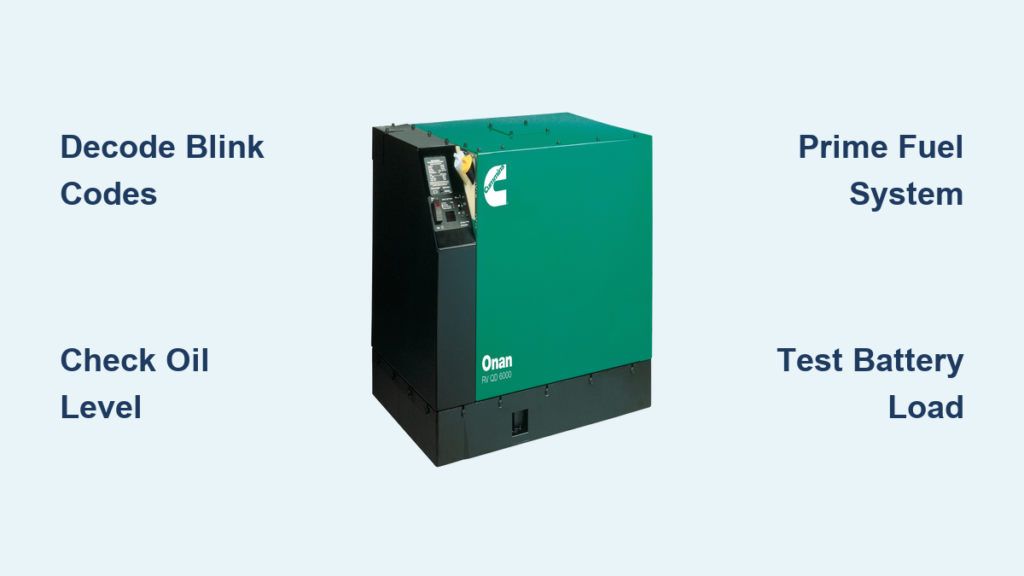
Your Onan generator sputters and dies during a critical power outage, leaving you stranded with spoiled food and dark rooms. That sinking feeling hits when blinking lights flash cryptic codes you can’t decipher. Most Onan generator failures stem from preventable issues that trained technicians fix in under 60 minutes. This guide cuts through the confusion with factory-approved Onan generator troubleshooting steps used by Cummins field engineers. You’ll learn to decode blinking patterns, diagnose fuel and electrical faults, and restore reliable power—no service call needed. Skip the guesswork and get your generator running tonight with these proven diagnostics.
Most breakdowns trace to five core systems: oil pressure, coolant temperature, fuel delivery, voltage regulation, and battery health. Before grabbing tools, ensure safety: disconnect the negative battery cable, close the fuel valve, and let the engine cool 5 minutes. Locate your model/spec numbers inside the control box—they’re essential for matching parts. Now, let’s tackle the most urgent failure codes starting with your status LED patterns.
Decode Fault Code Patterns

Read Blink Code Sequences
Press and hold STOP/PRIME for 3 seconds while in STOP mode. The status LED blinks two-digit fault codes—count pauses between sets. For example, three blinks, pause, six blinks equals code 36. Each sequence repeats three times with 5-second gaps. Write down all active codes before clearing; they reveal the exact failure sequence. Never clear codes prematurely—you’ll lose critical diagnostic history needed to catch intermittent issues. This 30-second check prevents hours of misdiagnosis.
Navigate Digital Display Codes
On newer models, use up/down arrows to scroll through solid (active) and flashing (historical) codes. Press SELECT to toggle between them. Clear codes only after repairs by holding SELECT for 7 seconds in STOP mode. Historical codes expose recurring problems—like a code 4 (overcrank) following code 10 (fuel pump circuit) indicating air-locked fuel lines. Checking both active and historical codes is non-negotiable for accurate Onan generator troubleshooting.
Fix Low Oil Pressure Issues
Check Oil Level First
Pull the dipstick with a cold engine. Oil must reach at least ¾ up the stick—add SAE 15W-40 CJ-4 to the full mark if low. Critical mistake: Adding oil without verifying actual pressure wastes time. Most code 1 shutdowns resolve with proper oil level, but 15% involve faulty components. Always retest after filling.
Test Oil Pressure Switch

Disconnect the oil pressure switch wire and jumper it to ground. If the code clears, replace the defective switch (opens below 4 psi). Pro tip: While cranking, monitor pressure at the port with a mechanical gauge—it must exceed 6 psi. Low readings mean sludge-blocked pickup tubes or scored oil pumps requiring teardown. This test takes 10 minutes but prevents unnecessary part replacements.
Diagnose Starting Failures
Overcrank Code Solutions
Code 4 means the engine cranked 15 seconds, rested 7 seconds, and failed three times. Don’t assume fuel pump failure—35% of cases are air-locked lines. First:
– Confirm ≥¼ tank fuel
– Verify flow: Catch ½ pint in 15 seconds at carb inlet
– Prime properly: Hold STOP/PRIME 30 seconds until steady fuel flows from return line
– Test battery: Must maintain ≥9.6V under 200-amp load
Visual cue: Listen for the fuel pump’s 2-second prime hum. No sound? Check fuse F1 before replacing the pump.
RPM Sense Loss Fixes
Code 3 appears when the controller loses RPM signal within 3 seconds of starting. Remove the flywheel screen and inspect the pickup gap—it must be exactly 0.020 inches. Test magneto resistance: 1,800-2,200 ohms primary, 5,000-7,000 ohms secondary. Common error: Ignoring flywheel key wear. Re-time the keyway and torque the nut to 85 ft-lbs if resistance tests pass but the engine still dies.
Repair Voltage Problems

Overvoltage Correction
When AC output exceeds 130V (120V models), code 6 sets. Emergency fix: Disconnect the voltage regulator and briefly flash 12V to the rotor. If voltage normalizes, replace the AVR (e.g., part 305-0982 for KY 4000 series). Warning: Never skip the flash test—40% of “bad AVRs” are actually worn brushes. Measure brush length; replace if under 0.31 inches.
Undervoltage Solutions
Code 7 indicates output below 90V at no load. Check these in order:
– Brushes: Replace at 0.31″ length (new = 0.67″)
– Slip rings: Machine if ridges exceed 0.005″
– Stator windings: Must read 0.2-0.4 ohms phase-to-phase
Pro tip: Perform the rotor flash test first—voltage rise confirms good AVR and points to brush wear. This avoids $200 AVR replacements for a $15 brush kit.
Fix Fuel System Failures
Fuel Pump Diagnostics
When the pump is silent and there’s no fuel pressure:
1. Direct test: Jumper 12V to the pump—it should draw 1.6-2.0 amps and produce 4 psi
2. Fuse check: Verify 5-amp fuse F1 is intact
3. Relay test: Measure coil resistance (65-85 ohms)
Critical visual: Cracks or frayed cords on the belt indicate radiator airflow issues causing overheating. Clean fins with compressed air from the engine side out—never water.
Carburetor Cleaning
Disassemble and ultrasonically clean passages for 10 minutes. Key specs:
– Main jet: 0.041″ (#65 drill)
– Idle jet: 0.020″
– Float level: 0.430″
Blow all passages with 90 psi air and install new gaskets (part 146-0788). Mistake to avoid: Using wire to clear jets—they distort critical orifices. Always use compressed air.
Optimize Battery Performance
Load Test Procedure
Weak batteries cause 30% of “no-start” codes. Charge at 10 amps for 4 hours, then load test at 200 amps for 15 seconds. Voltage must stay above 9.6V. Urgent action: Replace if CCA drops below 70% of rating. Test parasitic draw after 5 minutes shutdown—must be under 50 milliamps. Stuck isolation relays often drain batteries overnight.
Adjust Engine Components
Valve Adjustment Steps
With a cold engine:
– Intake: 0.004″ gap
– Exhaust: 0.006″ gap
Find TDC on compression stroke, adjust first pair, rotate 360 degrees, then adjust the rest. Torque rocker cover to 35 inch-pounds with a new gasket. Time-saver: Use a dial indicator to confirm TDC—prevents costly timing errors.
Compression Testing
Remove spark plugs and crank 5 seconds with wide-open throttle. Normal: 120-150 psi. Below 100 psi? Squirt 1 tsp oil in the cylinder—if pressure rises, rings are worn; if not, valves leak. This 5-minute test diagnoses internal engine health without teardown.
Prevent Future Failures
Maintenance Schedule
Follow these intervals religiously:
– 50 hours: Oil/filter change (1.6 qts 15W-40, filter 122-0836)
– 150 hours: Air filter clean (replace if black streaks)
– 300 hours: Fuel filter 149-2511 replacement
– 500 hours: Radiator fin cleaning
– 2,000 hours: Brush replacement and valve check
Pro insight: Load bank testing at 25%/50%/100% load for 5 minutes each catches voltage drift before failures. Voltage must stay within ±2%—deviations indicate stator or AVR issues.
Avoid Common Misdiagnoses
Fuel Pump vs. Air Lock
35% of “no-start” cases are misdiagnosed as fuel pump failure when air-locked lines are the real culprit. Always listen for the prime hum and verify 12V at the pump connector before part replacement. Prime for 30 seconds—steady fuel from the return line confirms proper flow.
AVR vs. Brush Wear
40% of low-voltage situations wrongly blame the voltage regulator. Perform the rotor flash test first—if voltage rises when flashing 12V to the rotor, brushes are worn (not the AVR). Measure brush length with calipers; replace at 0.31″.
Governor vs. Fuel Quality
25% of surging RPM complaints trace to contaminated fuel—not governor failure. Check fuel for water/debris and replace filter 149-2511 before replacing the $300 actuator. Always store fuel with stabilizer for generators used seasonally.
Your Onan generator delivers years of reliable backup power when you approach Onan generator troubleshooting systematically. Start with the simplest fixes—oil level, fuel flow, battery voltage—before diving into components. Keep a log of fault codes and repairs to spot patterns; recurring code 4 often means a clogged fuel filter needing earlier replacement. For persistent issues, contact Cummins Care at 1-800-888-6626 with your model/spec numbers—most problems resolve with their 24/7 guidance. Finally, perform load bank tests every 6 months to catch hidden failures. With these steps, you’ll transform from frustrated owner to confident generator technician.


