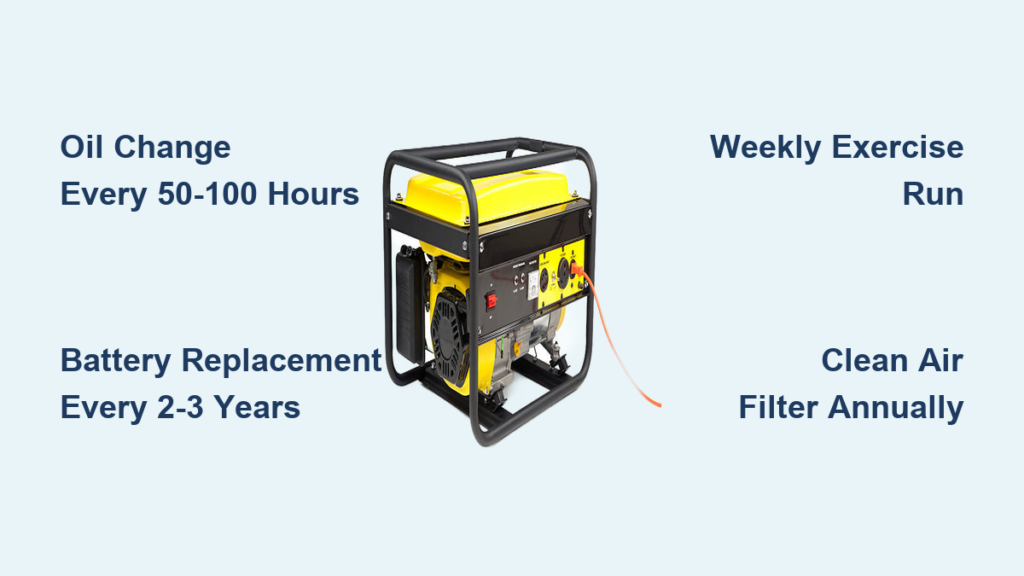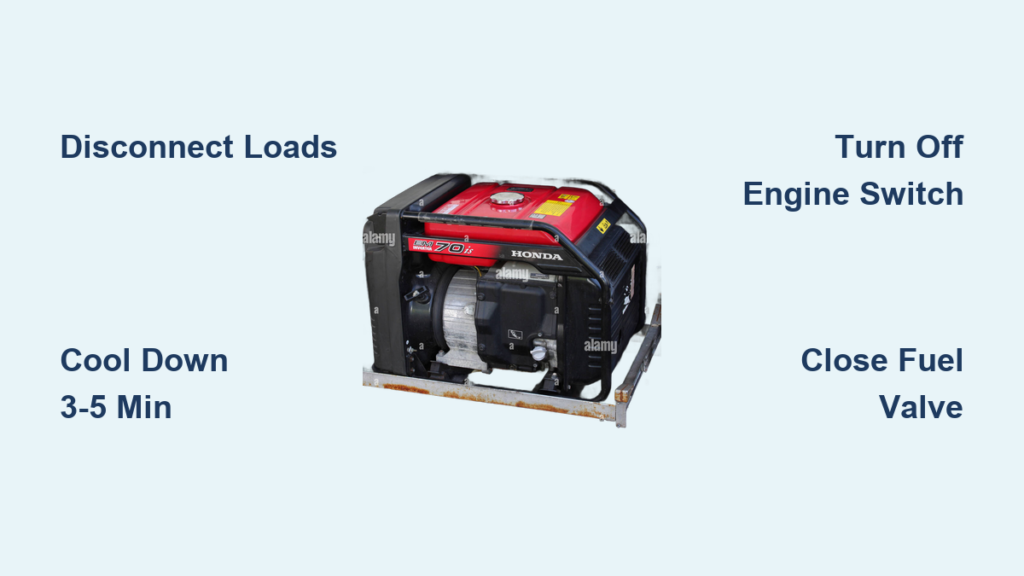
You’ve just powered through a weekend camping trip or finished a critical job site task with your Honda generator humming reliably. Now it’s time to shut it down—but hitting the “off” switch immediately could trigger expensive repairs. Many users unknowingly shorten their generator’s lifespan by skipping the critical 3–5 minute cool-down period or shutting down under load. Whether you own a compact EU2200i for tailgating or a heavy-duty EB10000 for construction sites, this guide delivers the exact shutdown sequence Honda engineers designed to protect your investment. Follow these steps to avoid carburetor flooding, inverter damage, and other costly mistakes that plague improper shutdowns.
Ignoring proper shutdown protocols risks thermal shock to sensitive components and potential fuel system damage. The good news? Mastering the correct technique takes under 10 minutes and prevents 80% of preventable generator failures according to Honda service data. In this guide, you’ll learn universal steps applicable to all models plus critical variations for inverter generators, dual-fuel systems, and industrial units. Most importantly, you’ll discover why that final fuel valve twist matters more than you think—especially before seasonal storage.
Disconnect All Electrical Loads Before Honda Generator Shutdown
Always unplug every device from your generator’s outlets before attempting shutdown. This includes RV power cords, construction tools, and even phone chargers. Running your Honda generator under load during shutdown sends dangerous voltage spikes through the system that can fry inverter circuitry in EU series models or damage the automatic voltage regulator (AVR) in conventional units like the EM5000SX.
How to Safely Stabilize Your Generator Before Powering Down
After disconnecting loads, let your Honda generator run unloaded for 3–5 minutes. Watch for the engine speed to stabilize—this indicates internal temperatures are equalizing. During this cool-down phase:
– Listen for RPM fluctuations (smooth idle = ready for shutdown)
– Check the voltage meter (should read steady 120V)
– Feel the exhaust (less heat = safer shutdown)
Skipping this step risks “thermal shock” where sudden temperature changes crack engine components. Pro tip: Set a phone timer—never guess the cool-down duration. For high-altitude operation above 5,000 feet, extend this period to 5 full minutes to let the fuel-air mixture normalize.
Locate and Operate Your Honda Generator’s Engine Switch Correctly

The engine switch location varies significantly across Honda models but always features clear “I/0” or “ON/OFF” markings. Never confuse this with the choke or throttle controls—using the wrong lever causes dangerous backfiring.
Model-Specific Engine Switch Operations
For EU Series Inverters (EU2200i, EU3000i):
1. Disable Eco-Throttle mode first (slide switch to OFF)
2. Flip the side-panel toggle switch firmly to OFF
3. Immediately turn the red carburetor bowl screw clockwise until snug
For Key-Ignition Models (EU7000iS, EB10000):
– Turn key counterclockwise to OFF position and remove immediately
– Wait for the fuel-injection light (yellow LED) to extinguish (up to 10 seconds)
– Never leave keys in the ignition during storage
If your generator won’t shut off after switching to OFF, check for a severed ignition wire at the coil—this common wiring fault keeps engines running despite switch position.
Close the Fuel Valve: The Critical Final Step for Honda Generators

After engine shutdown, always turn the fuel valve to OFF unless using the generator within 24 hours. This prevents fuel from seeping into the carburetor—a leading cause of “flooded engine” service calls. The valve location differs by model:
| Model Series | Fuel Valve Location | Visual Identifier |
|---|---|---|
| EU Inverters | Right-side red knob | Turns clockwise to close |
| EM/EB Deluxe | Black lever near tank | Pulls downward to OFF |
| EG Hand-Held | Petcock under tank | Turns 90° clockwise |
| EB10000 Industrial | Auto-solenoid | Manual valve under left panel |
For dual-fuel LPG models like the EU2200i Companion, additional steps are mandatory:
1. Turn fuel selector to OFF position
2. Let engine stall naturally (≈15 seconds)
3. Close LPG cylinder valve at the source
4. Pull recoil starter once without choke to bleed residual gas
Avoid These 3 Costly Honda Generator Shutdown Mistakes
Never Power Down Under Electrical Load
Shutting off while devices remain plugged in causes catastrophic voltage surges. Inverter generators like the EU3000i suffer permanent module damage from this single mistake—repair costs exceed $300. Always verify zero wattage on the display before proceeding.
Don’t Use Choke to Stop the Engine
Forcing shutdown via choke creates dangerous backfire that can:
– Crack the muffler housing
– Blow out spark plug seals
– Ignite fuel vapors near the air filter
Your generator’s engine switch exists for safe shutdown—use it exclusively.
Never Cut Fuel Valve While Engine Runs
Turning off the fuel supply mid-operation starves the carburetor of lubricating fuel, causing metal-on-metal contact that scores the float valve. This leads to chronic flooding and requires full carburetor rebuilds. Always shut down via engine switch first, then close the fuel valve.
Emergency Shutdown Procedures for Honda Generators
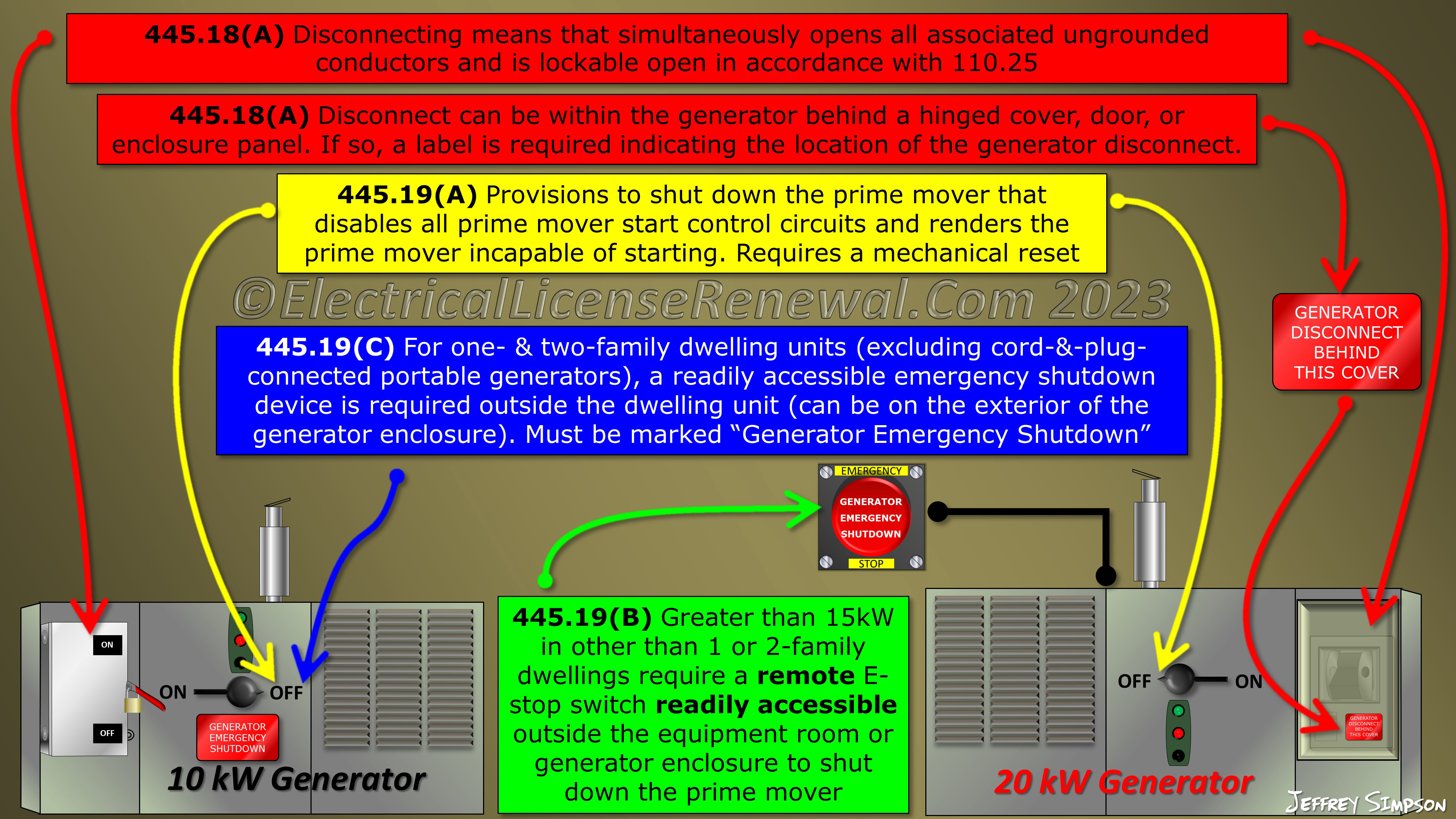
If your generator experiences runaway acceleration (engine RPMs suddenly spiking) or fire:
1. Immediately pull the stop lanyard (if equipped) or flip engine switch OFF
2. Shut fuel valve with gloved hand—this starves the fire of fuel
3. Use Class B fire extinguisher only (water spreads gasoline fires)
4. Evacuate and call 911 if flames persist beyond 30 seconds
Never attempt to move a running generator during emergencies—the tipping risk is extreme. Honda’s industrial models like the EG5000CL include red emergency stop buttons on control panels—familiarize yourself with this location before first use.
Post-Shutdown Maintenance Checklist for Longevity
Complete these critical tasks within 5 minutes of shutdown:
- Wipe exterior surfaces with dry cloth to remove salt spray or sawdust
- Check oil level—top up if below the dipstick’s lower mark (use 10W-30)
- Inspect air filter cover for debris blocking intake vents
- Secure fuel cap with quarter-turn until click (prevents vapor leaks)
- Coil cables neatly away from hot muffler surfaces
For generators stored over 30 days:
1. Drain carburetor bowl using 10mm wrench (EU series) or sediment cup (EM/EB)
2. Add fuel stabilizer to tank and run 10 minutes to circulate
3. Disconnect battery on electric-start models (EU7000iS, EM6500SX)
4. Store upright in ventilated area with fuel cap vent closed
Troubleshooting: Honda Generator Won’t Turn Off
Engine Runs Despite OFF Switch Position
This indicates severed ignition wiring—common after rough transport. Locate the ignition coil (usually near spark plug) and reconnect the black wire with a crimp connector. If the issue persists, inspect the stop switch for corrosion.
Brief Dieseling After Key Shutdown
When your EU7000iS or EB10000 “diesels” (continues running briefly after shutdown), hot carbon deposits are igniting fuel. Extend cool-down periods to 5 minutes and use fuel injector cleaner for 3 consecutive tanks.
Critical Safety Reminders for Every Honda Generator Shutdown
- Carbon monoxide danger: Always shut down outdoors—never in garages or tents
- Muffler burns: Keep children/pets 10+ feet away for 15 minutes post-shutdown
- Refueling wait time: Never add fuel within 15 minutes of shutdown (flash fire risk)
- Cold weather protocol: Open choke fully before shutdown if used in “Cold Start” mode
Mastering these shutdown procedures adds years to your Honda generator’s service life while preventing dangerous failures. Whether you’re powering down a $1,000 EU2200i after a weekend trip or an $8,000 EB10000 at a job site, these steps ensure reliable starts when you need power most. Remember: the 5 minutes you invest in proper shutdown saves hundreds in future repairs. Now, go enjoy that quiet campsite or tidy worksite—your generator’s ready for its next duty cycle.