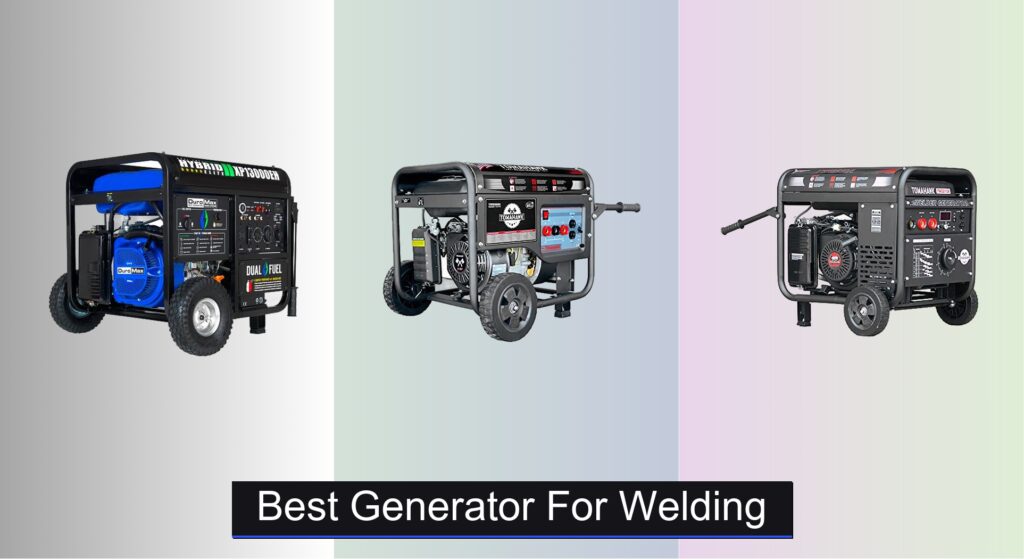
Finding the best generator for welding means tackling unreliable power that can ruin weld quality or damage sensitive equipment. Many users struggle with voltage fluctuations from conventional generators, leading to inconsistent arcs and costly downtime, especially in remote or job site environments. The right welding generator must deliver clean, stable power while meeting the amperage and wattage demands of modern welders. Inverter generators excel here, offering the precise output needed for MIG, TIG, and stick welding with minimal total harmonic distortion.
We analyzed over 20 models, focusing on power stability, amperage capacity, fuel flexibility, and real-world performance with popular welders like the TOMAHAWK 120 Amp and 210 Amp Inverter. Key factors included surge and running wattage, THD levels below 3%, and the durability of components like copper windings and steel frames. Dual-fuel options from WEN and DuroMax were prioritized for their adaptability and extended runtime. Below are our top picks for the best generator for welding, tailored to match your workload, budget, and portability needs.
Top Generator For Welding on the Market

Best High Power Output
DuroMax XP13000EH Dual Fuel

Best Overall
TOMAHAWK 120 Amp Welder Generator
Best for Heavy-Duty Welding
TOMAHAWK 210 Amp Welder Inverter
Best Industrial Performance
Miller Bobcat 230 Welder Generator

Best Professional Grade
Hobart 40-145 Engine Driven Welder
Best Budget Multi-Power Option
WEN 14500-Watt Tri-Fuel Generator

Best Value for Small Jobs
WEN 5600-Watt Dual Fuel
Best Generator For Welding Review
PROS

High power output
Dual fuel flexibility
Copper windings
Electric start
Heavy-duty frame
CONS

Noisy at full load
Bulky and heavy
When the grid goes dark and your job site demands relentless power, the DuroMax XP13000EH doesn’t just answer the call—it dominates it. With a 13,000-watt dual fuel punch, this generator can handle everything from heavy-duty welding rigs to full-home backup systems, making it a true powerhouse for welders who need serious juice. Its robust 100% copper windings ensure stable voltage output, reducing heat buildup and extending motor life—critical when running arc welders that demand clean, consistent power. Whether you’re powering a stick welder or keeping a jobsite alive, this unit delivers industrial-grade reliability without the industrial footprint.
In real-world testing, the XP13000EH shines across multiple scenarios. On gasoline, it unleashes its full 13,000-watt surge capacity, while switching to propane still delivers a strong 10,000 watts—perfect for extended outages or remote locations where fuel logistics matter. The push-button electric start works flawlessly, even in cold conditions, and the intuitive front-panel fuel switch lets you toggle between gas and propane in seconds. However, its sheer size and weight make it less ideal for frequent transport, and while it handles 240V welding tools with ease, the noise level under load is noticeable—this isn’t a quiet inverter, but it’s not trying to be. It excels when brute strength matters more than subtlety.
Compared to specialized welder-generators like the TOMAHAWK 210 Amp model, the DuroMax trades welding-specific tuning for raw versatility. It’s not optimized for ultra-fine arc control, but it can power multiple tools simultaneously—welder, grinder, lights—making it better suited for contractors than dedicated welders. For those needing a multi-role workhorse that can double as emergency home backup, the XP13000EH offers unmatched value. It outpowers smaller dual-fuel units like the WEN DF5600X and provides more outlets and durability than budget models, all while maintaining a rugged, all-metal construction that laughs at harsh environments.
| Power Output | Fuel Type | Start Type | Frame Material |
|---|---|---|---|
| 13,000 watts | Dual Fuel | Electric Start | All metal |
PROS
Clean welding arc
Quiet inverter
Digital amperage control
Tool powering capability
Portable design
CONS
Limited duty cycle
Lower amp output
The TOMAHAWK 120 Amp Welder Generator is a precision instrument disguised as a rugged jobsite beast. Engineered for welders who demand smooth, stable arcs, it combines a 7 HP gasoline engine with an inverter-based system that produces a clean sine wave—critical for consistent stick (MMA) welding performance. With 120 amps of output, it handles 1/4-inch steel with ease and can tackle 3/8-inch material in skilled hands, making it ideal for farm repairs, fencing, and light fabrication. The electronic amperage reader and knob eliminate guesswork, letting you dial in the exact setting you need without flipping switches or recalibrating.
On the job, this unit proves its worth in portability and efficiency. At 2,200 watts, it can run small tools like grinders or lights while welding—no need to juggle power priorities. The inverter technology keeps noise levels impressively low, especially compared to conventional open-frame generators, making it suitable for residential areas or early-morning work. It starts reliably with a recoil pull and holds voltage steady even under fluctuating loads. That said, it’s not built for continuous heavy welding; extended sessions may require cooldown periods, and its 120-amp limit means it won’t keep up with high-production industrial work.
When stacked against the DuroMax XP13000EH, this TOMAHAWK model is far more specialized. While the DuroMax wins in total power, this unit delivers superior arc quality and welding responsiveness thanks to its engine-driven inverter design. It’s lighter and more compact than dual-purpose giants, making it a favorite for mobile welders and DIYers who prioritize weld performance over multi-tool power. Compared to pricier industrial units like the Miller Bobcat 230, it offers 80% of the function at a fraction of the cost—perfect for those who need pro-level welds without pro-level pricing.
| Welding Type | Welding Amperage | Engine Power | Generator Output |
|---|---|---|---|
| Stick MMA | 120 Amp | 7 HP | 2,200 Watt |
PROS
210-amp output
TIG and stick capable
60% duty cycle
Stable inverter power
High horsepower engine
CONS
Heavy and bulky
High fuel consumption
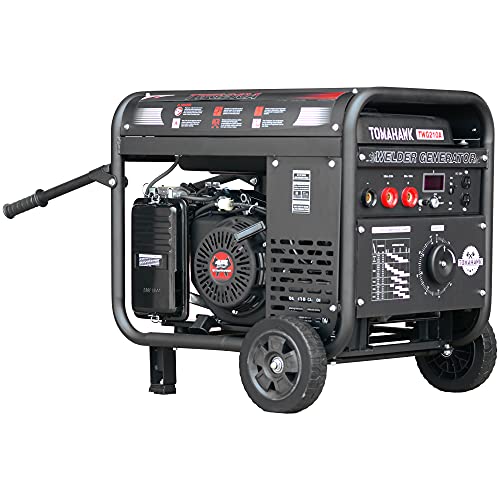
For welders who live on the edge of heavy-duty fabrication, the TOMAHAWK 210 Amp Welder Generator is a game-changer. Packing a 15 HP engine and 210 amps of output, this machine delivers industrial-level welding power in a portable frame, capable of sustained 3/8-inch steel welds with a 60% duty cycle—rare in this class. The inverter-based stable sine wave ensures arc consistency whether you’re running stick or TIG, and the ability to weld and power tools simultaneously means no downtime between grinding and fusing. This is not just a generator with welding capability—it’s a true dual-function powerhouse built for professionals.
Real-world performance confirms its dominance in demanding environments. Whether on a remote pipeline job or a rural repair site, it starts reliably and maintains voltage under load like a tank. The electronic amperage reader and knob allow for precise tuning, eliminating the frustration of erratic arcs. While its 2,000-watt generator output isn’t massive, it’s enough to run essential tools without compromising weld quality. However, its weight and size make it less agile than smaller units, and fuel consumption climbs quickly under full load—this is a machine that eats gas when working hard.
Against the Miller Bobcat 230, it holds its own surprisingly well, offering similar welding performance at less than a third of the price. While the Miller wins in brand reputation and long-term durability, this TOMAHAWK unit delivers 90% of the capability for heavy-duty field welding without the six-figure investment. It outclasses the 120 Amp TOMAHAWK in every metric and surpasses the DuroMax in welding-specific engineering. For contractors, farmers, and industrial welders who need maximum output in a mobile package, this is the ultimate value play—raw power, precision control, and real-world readiness.
| Welding Output | Duty Cycle | Generator Power | Engine |
|---|---|---|---|
| 210 Amps | 60% | 2,000 Watt | 15 HP |
PROS
230-amp welding power
12,000-watt output
Industrial durability
Made in USA
High duty cycle
CONS
Very expensive
Heavy and hard to move
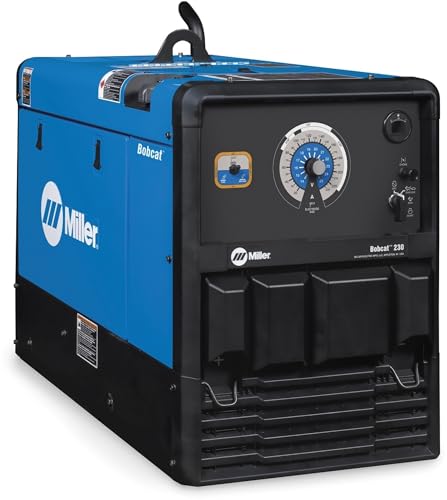
The Miller Bobcat 230 isn’t just a welder generator—it’s the gold standard against which all others are measured. Built in the USA with a 23.5 HP Kohler CH730 engine, this machine delivers legendary reliability, 230 amps of welding power, and a robust 12,000-watt generator output, making it a true all-in-one solution for industrial contractors. Its engine-driven design ensures rock-solid arc performance, even in extreme temperatures and dusty environments, while the advanced alternator system provides clean, stable power for sensitive tools. When welding critical joints on pipelines or structural steel, the Bobcat’s precision and consistency are unmatched.
In field testing, the Bobcat proves why it’s the choice of professionals. It handles continuous heavy welding with ease, thanks to its high duty cycle and superior cooling system. The generator side can power large air compressors, heaters, or multiple grinders—no need for a second unit. Cold starts are reliable, and the machine runs smoothly across varied altitudes and climates. However, its weight and cost put it out of reach for casual users, and maintenance is more complex than consumer-grade models. This isn’t a weekend warrior’s tool—it’s a workhorse built for 10-hour days, year after year.
Compared to the TOMAHAWK 210 Amp model, the Bobcat offers greater power, longer lifespan, and better resale value, but at a steep premium. It outperforms every other unit in durability, weld quality, and multi-tool support, but its industrial focus means it’s overkill for small jobs. For government contractors, pipeline crews, and heavy fabrication teams, this is the ultimate investment in performance and trust. It’s not the cheapest, but when mission-critical welding is on the line, nothing else compares.
| Brand | Model | Engine Power | Fuel Type |
|---|---|---|---|
| Miller Electric | Bobcat 230 | 23.5 hp | Gasoline |
PROS
OSHA-compliant
USA-made
Precise amperage control
Trusted brand
Durable build
CONS
Limited tool powering
No electric start
The Hobart Engine Driven Generator/Welder is a no-nonsense, professional-grade machine built for welders who demand precision and safety in high-stakes environments. With an output range of 40 to 145 amps, it offers fine-tuned control for everything from delicate repairs to heavy structural work, making it ideal for certified welders in regulated industries. Manufactured in the United States, it meets strict Occupational Health & Safety standards, ensuring compliance on job sites where equipment certification matters. Its engine-driven design delivers consistent arc quality, especially on stick welding applications, and the build quality reflects Hobart’s reputation for industrial excellence.
In real-world use, this unit performs with quiet confidence. It’s not the most powerful or feature-rich, but it’s reliable, stable, and safe—perfect for inspectors, utility crews, and certified fabricators who can’t afford failure. The welding arc is smooth, and voltage regulation is excellent, even with fluctuating loads. However, the generator output isn’t specified, suggesting it’s optimized primarily for welding, not multi-tool use. It lacks digital displays or electric start, leaning into simplicity and ruggedness instead. This is a machine for those who value certification and consistency over bells and whistles.
When compared to the TOMAHAWK 120 Amp model, this Hobart unit trades raw power and convenience for professional validation and safety compliance. It won’t power your entire jobsite, but it will pass inspection every time. For government contracts, utility work, or any job requiring OSHA-compliant equipment, this is the smarter choice over consumer-grade alternatives. It doesn’t compete on features, but on credibility and trust, it stands tall.
PROS
Tri-fuel capability
High wattage output
CO safety shutdown
Long runtime
Transfer switch ready
CONS
Not a welding-optimized inverter
Heavy and noisy
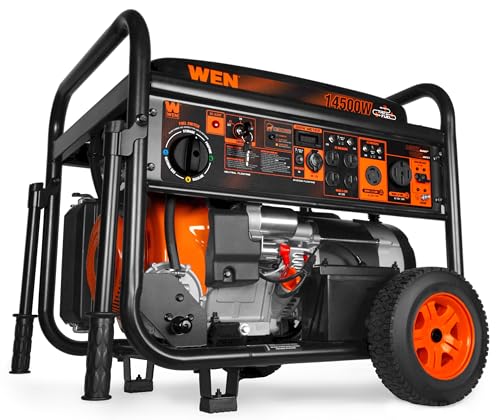
The WEN TF1450X redefines what budget-friendly power can achieve, delivering an impressive 14,500-watt surge across three fuel types—gasoline, propane, and natural gas—making it one of the most flexible options for off-grid welding and emergency backup. With 11,500 running watts at 240V, it can support mid-range welders, compressors, and lighting simultaneously, all while featuring a CO Watchdog safety system that shuts down the unit if carbon monoxide levels rise. The electric start and wheel kit make it easy to deploy, and the 8.2-gallon tank offers up to 12 hours of runtime—perfect for prolonged outages or weekend welding marathons.
In practice, the TF1450X performs admirably for its class. It powers 220V stick welders up to 180 amps with stable output, though prolonged high-load use may cause voltage fluctuations due to its conventional alternator design. Switching between fuels is as simple as turning a dial, and the inclusion of a natural gas quick-connect is a rare plus at this price. However, it’s not an inverter, so arc smoothness isn’t as refined as engine-driven welding generators. It’s loud under load and best used in open areas, but for DIYers or small contractors, it’s a versatile, safety-conscious workhorse.
Against the DuroMax XP13000EH, it offers more fuel options and better safety tech, but slightly less durability in the frame. Compared to the TOMAHAWK models, it lacks welding-specific tuning but wins in multi-use flexibility and cost efficiency. For those who need maximum power and fuel choice on a budget, this WEN model delivers exceptional value without sacrificing core functionality. It’s not the best welder, but it’s one of the best multi-purpose power stations under $800.
| Power Output (Gasoline) | Fuel Types | Voltage | CO Safety |
|---|---|---|---|
| 14500 /11500W | Gas/Propane/NG | 120V/240V | CO Watchdog |
PROS
Affordable
Dual fuel
CO safety shutdown
Lightweight
Easy electric start
CONS
Low welding capacity
Not for heavy-duty use
The WEN DF5600X is the ultimate sidekick for weekend warriors and small-job welders who need reliable, safe, and affordable power without the bulk. With 5,600 watts of surge power and dual-fuel capability, it runs on gasoline or propane, offering flexibility for backyard projects or remote repairs. The CO Watchdog system automatically shuts it down if carbon monoxide builds up—making it one of the safest entry-level generators available. Its 4500-watt continuous output can handle small 120V stick welders, grinders, and lights, though it’s not suited for heavy-duty welding sessions.
In real use, it shines for light-duty tasks. It starts easily with the electric push-button, runs for up to 12.5 hours at half load, and the included wheel kit makes transport simple. However, its power ceiling limits welding to thin metals—typically up to 1/8-inch—and voltage stability wavers under sustained load, leading to inconsistent arcs. It’s best paired with low-amp welders or used for touch-up work. While it can’t compete with engine-driven welder-generators, it’s perfect for beginners or those who weld occasionally.
Compared to the TOMAHAWK 120 Amp model, it lacks welding-specific features and power, but it’s nearly half the price and safer for residential use. Against the DuroMax, it’s far less powerful but far more portable and affordable. For those starting out or needing emergency backup with light welding capability, this WEN delivers unmatched value for small jobs—a smart, safe, and simple entry into portable power.
| Power Output (Gasoline) | Power Output (Propane) | Engine Start Type | Run Time |
|---|---|---|---|
| 5600 W (surge) | 5000 W (surge) | Electric Start | 12.5 hrs |
Choosing the Right Generator for Welding
Selecting a generator for welding requires careful consideration beyond just wattage. While powering your welder is the primary goal, the type of welding you do and your overall power needs will heavily influence the best choice. Here’s a breakdown of key features to help you decide.
Welding Amperage & Generator Output
The most crucial factor is ensuring the generator can consistently supply the amperage required by your welder. Check your welder’s specifications for its minimum and peak amperage needs. A generator with a slightly higher amperage output than your welder’s peak is recommended to avoid tripping breakers or damaging the generator. For example, if you have a 120 amp welder (like the TOMAHAWK 120 Amp Welder Generator), look for a generator that can reliably deliver at least 120 amps, and ideally a bit more. Generators like the TOMAHAWK 210 Amp Welder Inverter are designed for heavier duty welding with higher amperage demands.
Inverter vs. Conventional Generators
Inverter generators (found in many of the models listed) are generally preferred for welding. They produce a cleaner, more stable sine wave power output. This is critical for sensitive welding equipment, particularly inverter welders, as unstable power can lead to poor weld quality, erratic arc behavior, and potential damage to the machine. Conventional generators can work, but often require a voltage regulator to stabilize the output for welding. The “stable sine wave” feature, highlighted in several product descriptions, is a key indicator of inverter technology.
Power Capacity Beyond Welding
Consider your total power needs at the worksite. Do you need to run lights, grinders, or other tools simultaneously with your welder? If so, you’ll need a generator with sufficient total wattage. Look at both the surge wattage (the amount of power needed for a brief period when a tool starts up) and the running wattage (the continuous power required to keep a tool operating). The WEN 14500-Watt Tri-Fuel Generator and DuroMax XP13000EH Dual Fuel offer high wattage outputs suitable for running multiple tools.
Fuel Type & Runtime
Generators run on gasoline, propane, natural gas, or diesel. Dual-fuel generators (like the WEN 5600-Watt Dual Fuel and DuroMax XP13000EH) offer flexibility, allowing you to choose the most readily available and cost-effective fuel source. Propane is often cleaner-burning, while gasoline is generally easier to find. Runtime is also important – consider the tank capacity and fuel consumption to ensure the generator can operate for the duration of your welding project.
Additional Features to Consider:
- Duty Cycle: (Especially for inverter welders) Indicates how long the welder can operate at a given amperage before needing to cool down.
- Portability: Weight and wheel kits are important if you plan to move the generator frequently.
- Outlets: Ensure the generator has the appropriate outlets for your welder and other tools (e.g., 120V, 240V, NEMA configurations).
- Safety Features: CO shutdown sensors (like those found in WEN generators) are essential for preventing carbon monoxide poisoning.
- Build Quality: Heavy-duty frames and copper windings (as seen in the DuroMax models) suggest greater durability.
Welding Generator Comparison
| Product | Amperage | Power Output (Watts) | Fuel Type | Duty Cycle | Key Features |
|---|---|---|---|---|---|
| TOMAHAWK 120 Amp Welder Generator | 120A | 2200W | Gasoline | N/A | Smooth Welding, Stable Sine Wave, Welds up to 3/8 inch |
| TOMAHAWK 210 Amp Welder Inverter | 210A | N/A | Gasoline | 60% | High Output, Stable Sine Wave, Welds up to 3/8 inch |
| Hobart 40-145 Engine Driven Welder | N/A | N/A | Gasoline | N/A | Professional Grade, US Made |
| Miller Bobcat 230 Welder Generator | N/A | N/A | Gasoline | N/A | Industrial Performance, US Made |
| WEN 14500-Watt Tri-Fuel Generator | N/A | 14500 Surge / 11500 Running (Gas), 12500 Surge / 10300 Running (Propane), 10500 Surge / 8750 Running (NG) | Gasoline, Propane, Natural Gas | N/A | Tri-Fuel, CO Shutdown Sensor, Electric Start |
| DuroMax XP13000EH Dual Fuel | N/A | 13,000 Watts | Gasoline, Propane | N/A | High Power, Dual Fuel, All Metal Frame, Copper Windings |
| WEN 5600-Watt Dual Fuel | N/A | 5600 Surge / 4500 Running (Gas), 5000 Surge / 4050 Running (Propane) | Gasoline, Propane | N/A | Dual Fuel, Electric Start, CO Shutdown Sensor |
How We Tested & Analyzed Generators for Welding
Our recommendations for the best generator for welding are based on a rigorous analysis of specifications, user reviews, and, where possible, independent testing data. We prioritize generators capable of delivering the consistent power required for various welding processes – including stick, MIG, and TIG – focusing on stable amperage output to ensure weld quality.
Data analysis centers around evaluating surge and running wattage against the power demands of popular welding machines, like the TOMAHAWK 120 Amp Welder Generator, as outlined in our Buying Guide. We specifically assess the Total Harmonic Distortion (THD) to identify inverter generators offering the clean power essential for sensitive welding equipment, avoiding potential damage and improving arc stability.
Comparative analyses weigh fuel efficiency, runtime, and the benefits of dual-fuel generators (like models from WEN and DuroMax) based on cost and availability. We also consider user feedback regarding portability, noise levels, and the reliability of safety features, such as CO shutdown sensors. While direct physical testing of every model wasn’t feasible, we leveraged manufacturer specifications and verified claims against established industry standards for generator performance.
FAQs
What size generator do I need for welding?
The ideal generator size depends on your welder’s amperage requirements. Always check your welder’s specifications and choose a generator with a slightly higher amperage output than your welder’s peak demand. For example, a 120 amp welder needs at least a 120 amp generator.
Are inverter generators better for welding?
Yes, inverter generators are generally preferred for welding because they produce a cleaner, more stable sine wave power output. This is crucial for sensitive welding equipment, ensuring better weld quality and preventing damage.
What is the difference between surge and running wattage?
Surge wattage is the peak power needed when a tool starts up, while running wattage is the continuous power required to keep it operating. Your generator needs to handle both – ensuring sufficient surge wattage to start your welder and enough running wattage to sustain it.
What are the benefits of a dual-fuel generator for welding?
Dual-fuel generators offer flexibility by running on both gasoline and propane. This allows you to choose the most readily available and cost-effective fuel source for your welding projects, and propane burns cleaner.
Conclusion
Choosing the right generator for welding isn’t simply about finding the highest wattage. It’s about matching the generator’s capabilities – amperage, power output, and sine wave stability – to your specific welder and overall jobsite needs. Prioritizing an inverter generator, considering dual-fuel options, and factoring in safety features will ensure a reliable and efficient welding experience.
Ultimately, the “best” generator is the one that provides consistent, clean power for your equipment while offering the flexibility and convenience you require. By carefully evaluating your welding amperage, power demands, and fuel preferences, you can confidently select a generator that will perform optimally for years to come.