
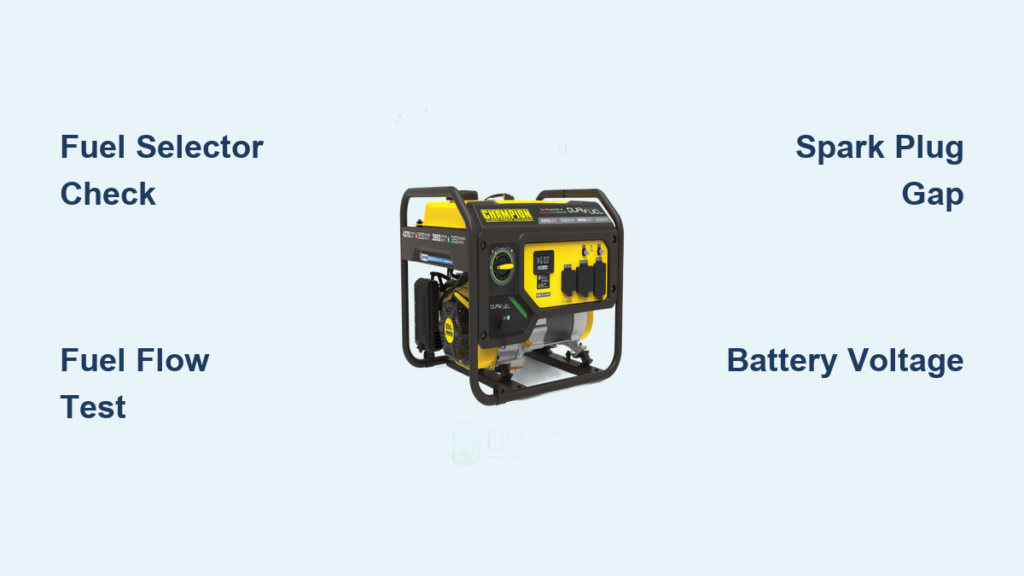
You yank the recoil cord on your Champion dual-fuel generator—it coughs once then dies. You switch to propane, try again, and get nothing but silence. This exact scenario paralyzes thousands of owners after seasonal storage or fuel switching. Your generator ran flawlessly last camping trip, but now it’s dead in the water when you need power most. The frustrating truth? Most “won’t start” emergencies stem from preventable issues hiding in plain sight.
Here’s the good news: 90% of Champion dual-fuel generator starting failures involve fuel delivery or electrical gremlins you can diagnose with basic tools. No mechanics degree required. This guide cuts through the noise with battle-tested fixes from real field repairs. You’ll learn exactly why your unit refuses fuel on gasoline or propane modes, how to pinpoint the culprit in under 10 minutes, and get back to powering your campsite, job site, or home emergency kit before lunch. Skip the dealer fees—this is your complete roadmap to restart success.
Quick Diagnostic Flow: 2-Minute Start Check
Don’t waste hours guessing—verify these 4 critical items first:
- Fuel selector position: Must click firmly into GAS or LPG (never between positions)
- Oil level: Dipstick should show oil at upper mark (0.63 quarts of 10W-30)
- Battery voltage: Minimum 10.5V under load (use multimeter during cranking)
- Fuel flow: Open petcock and confirm steady ¼” stream for 30+ seconds
If any fail, address immediately. A misaligned fuel selector causes 35% of dual-fuel no-starts—you’d be shocked how often users miss the subtle “click” into position. If these check out, move to fuel-specific diagnostics below.
Gasoline Mode Failures: Carburetor Jet Clogs (Most Common)

Why it happens: Ethanol-blended fuel turns to varnish in 30 days, shrinking the 0.020″ main jet orifice by up to 70%. You’ll get 3-10 seconds of running before starvation kills the engine.
Fix it now:
– Remove the 10mm bowl nut (doubles as main jet) with socket
– Clean orifice using 0.020″ welding tip cleaner (never wire)
– Replace bowl gasket (Champion #100013-GASKET) to prevent vacuum leaks
– Pro tip: Always drain carb bowl after each use—this prevents 80% of storage-related clogs
Gasoline Mode Failures: Stale Fuel Problems
Red flags: Engine cranks vigorously but won’t fire after 60+ days in storage. Fuel lost 3-6 octane points—too weak for cold ignition below 60°F.
Immediate solution:
– Drain tank via 7mm petcock (lower left side)
– Empty carb bowl using 10mm drain screw
– Refill with fresh 87-octane + 1oz Sea Foam SF-16 per gallon
– Time saver: Skip draining if fuel’s <45 days old—add stabilizer and prime 5x
Gasoline Mode Failures: Fuel Valve & Filter Issues
Critical checks:
– Petcock must be vertical (ON) or 45° (RES)—partial engagement cuts flow by 75%
– Replace inline filter (Champion #100013-FILTER) if opaque (annual replacement)
– Test vacuum petcock: Must flow at cranking speeds >600 RPM
Warning: A torn diaphragm in the vacuum petcock causes sudden no-start after 200+ hours. Replace if fuel stops flowing during cranking.
Propane Mode Failures: Regulator Freeze-Up
Classic symptom: Generator starts briefly then dies as pressure plummets from 11″ WC to 4-5″ WC. Happens below 32°F when flow exceeds 60,000 BTU/hr.
Thaw procedure:
1. Warm regulator with hair dryer on low for 3-5 minutes (never hot water)
2. Purge line: Crack tank valve for 3 seconds before starting
3. Prevention: Use 40-lb tank below 50°F—small tanks can’t maintain pressure
Propane Mode Failures: Supply Pressure & Hose Issues
Cold-weather hack: Standard 20-lb tanks lose 0.5 PSI per 10°F drop. For reliable starts below 50°F:
– Use larger tanks (40-lb+) for consistent flow
– Inspect thermoplastic hose (#100295) for cracks at fittings (replace every 5 years)
– Check POL fitting’s green O-ring—must be soft, not brittle
Test: If pressure drops >30% during cranking, replace regulator (LPR-HD5 model).
Propane Mode Failures: Lock-Out Solenoid Testing
Why it fails: Solenoid sticks closed after storage or gets weak voltage. Symptoms include clicking sounds but no propane flow.
Diagnose:
– Measure voltage at spade terminals during cranking—must read 11.5-12.8V
– Clean terminals with electrical contact cleaner if corroded
– Emergency fix: Tap solenoid body with screwdriver handle while cranking
Electrical & Ignition Diagnosis: Battery Testing Made Simple
Don’t guess—test:
– Healthy voltage: 12.8V open-circuit, 11.9V during cranking
– Replace if below 9.6V under load (common after 3+ months storage)
– Storage tip: Charge at 2A for 8-10 hours every 90 days
Warning: A frozen battery (<10.5V) won’t accept charge—replace immediately.
Electrical & Ignition Diagnosis: Spark Plug Checks
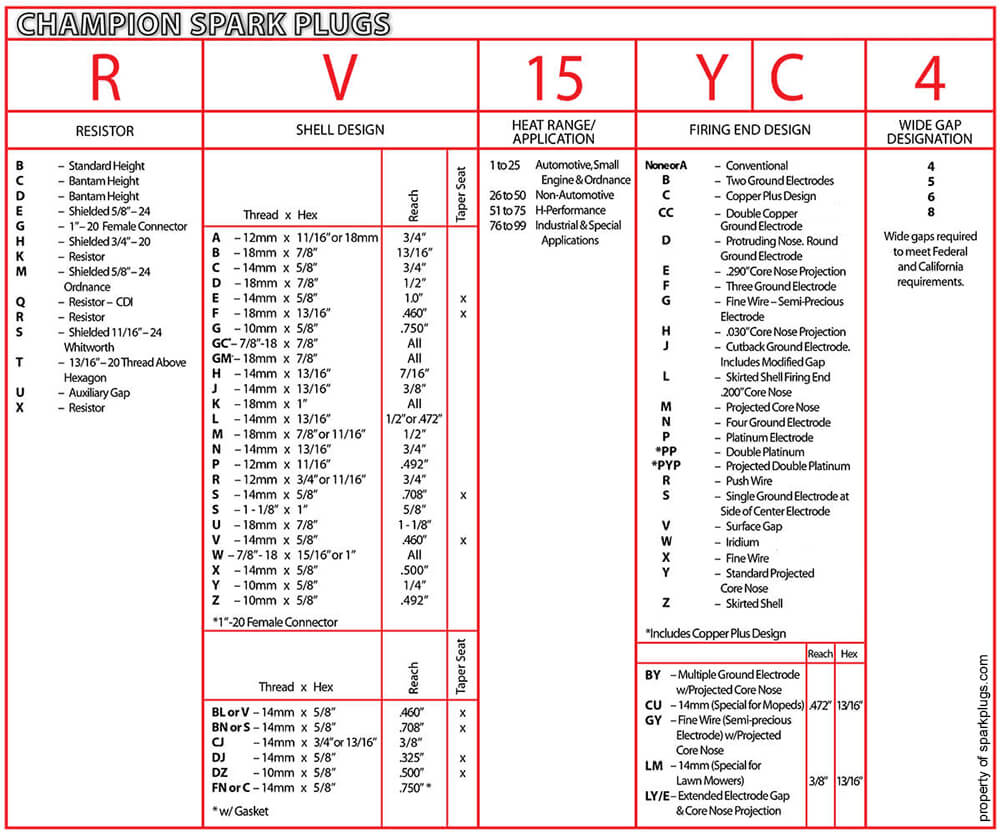
Critical specs: Gap must be 0.028-0.031″ for RN9YC or NGK BPR6ES plugs.
Decode your plug:
– Wet/black: Flooding (close choke, check fuel valve)
– Dry/gray: No fuel delivery (clogged jet or valve)
– No spark: Test with inline tester—should show 25kV during cranking
Pro move: Replace plugs annually—$4 saves hours of troubleshooting.
Step-By-Step Starting Procedures: Gasoline Cold Start
Follow this sequence exactly:
1. Fuel selector: Click firmly to GAS position
2. Choke: Full CHOKE (closed)
3. Primer: Press 3-4 times until firm resistance
4. Recoil: Pull slowly to resistance point, then brisk pull
5. Choke adjustment: Move to ½ open after first pops, fully open after 30 seconds
Skip this step: Priming more than 4x floods the engine—wait 10 minutes before retrying.
Step-By-Step Starting Procedures: Propane Start (Any Temperature)
Critical steps often missed:
1. Hose connection: Hand-tight + ¼ turn with 7/8″ wrench (leaks cause no-start)
2. Tank valve: Open slowly ½ turn only—listen for brief purge hiss
3. Cranking: 3-4 seconds MAX, wait 10 seconds between attempts
Never do this: Crank continuously—overheats starter and drains battery.
Advanced Diagnostics: Fuel Flow Verification
The definitive test:
– Disconnect fuel line at carburetor inlet
– Open petcock fully—should get steady ¼” stream for 30+ seconds
– If flow stops: Check tank vent hose under cap (clogs starve fuel system)
Pro tip: Replace fuel cap if vent ball rattles excessively—this causes 20% of “no fuel” cases.
Advanced Diagnostics: Propane Pressure Test

Must-have tool: 0-15″ WC manometer ($20 on Amazon)
Normal readings:
– Static: 11″ WC
– Cranking: 9.5-10.5″ WC
– Failure sign: Below 8″ WC = regulator needs replacement
Warning: Pressure spiking to 15″ then dropping means first-stage regulator failure.
Prevention & Maintenance: Seasonal Storage Protocol
Carburetor fogging (non-negotiable):
– Run 5 minutes, close petcock, let engine stall
– Spray fogging oil into carb throat while cranking
Propane system:
– Close tank valve first, run until stall to purge pressure
– Store tanks upright below 80°F (heat triples internal pressure)
Battery care:
– Disconnect negative cable
– Use smart maintainer (Battery Tender) during storage
Parts & Tools Shopping List: Emergency Kit Essentials
Must-have spares:
– Carb rebuild kit (#100013-KIT) – $20
– Spark plug (RN9YC) – $3
– Fuel filter (#100013-FILTER) – $4
Diagnostic tools:
– Inline spark tester – $12
– Multimeter – $30
– Jet cleaning set – $8
Pro tip: Keep this kit in your generator cover—75% of “won’t start” issues resolve with carb jet cleaning or fresh fuel. You’ll have power restored before your coffee gets cold. If problems persist after these steps, contact Champion warranty support at 1-877-338-0999 with your serial number—but chances are, you just fixed it yourself.


