
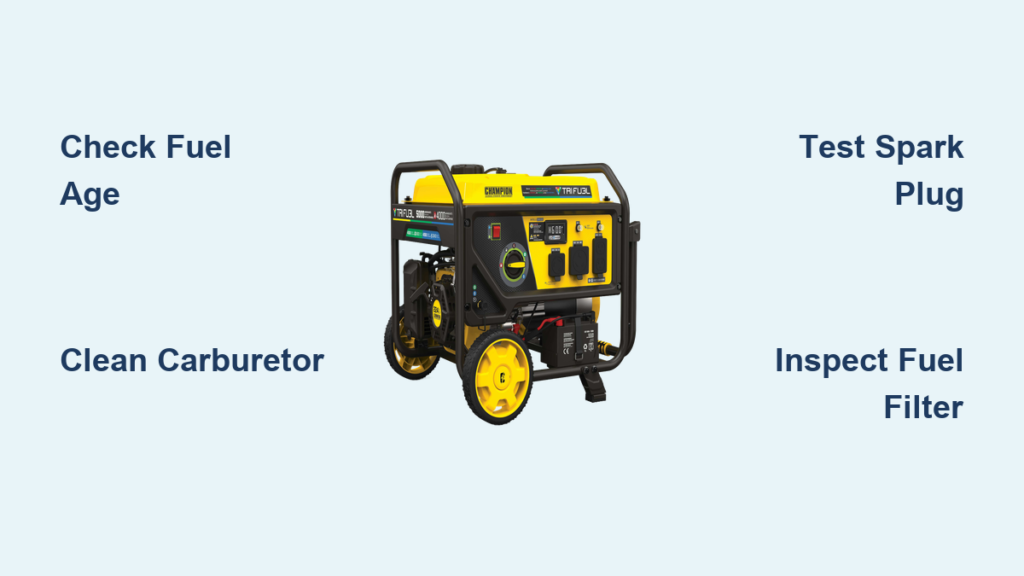
Your Champion generator fires up with a roar, runs for just a few seconds, then suddenly dies—leaving you stranded without power when you need it most. This frustrating “starts but won’t stay running” issue affects thousands of Champion generator owners each year, but here’s the good news: in over 90% of cases, you can diagnose and fix this problem yourself in under an hour without special tools.
This common Champion generator starts then dies problem usually stems from simple, fixable issues rather than major engine failure. Whether your generator runs for 2 seconds or 30 before quitting, the systematic troubleshooting approach in this guide will help you identify the exact cause and get your power back online quickly—no mechanic required.
Quick Diagnostic Before You Begin
Start with these three 30-second checks that solve 60% of start-then-die issues immediately:
Check your fuel age – If gasoline sits longer than 30 days, it breaks down and forms varnish that clogs critical carburetor passages. Old ethanol-blended fuel also attracts moisture, causing phase separation that prevents proper running.
Test the oil level – Champion generators have automatic low oil shutdown that triggers when oil drops below the “low” mark. Fill to the absolute full line—not just above minimum—before testing further.
Remove the air filter – A clogged filter restricts airflow, creating an overly rich fuel mixture that causes stalling. If it looks dark gray or black, replace it immediately rather than wasting time on deeper diagnosis.
Fuel System Failures That Kill Engines

Bad Gas Symptoms to Spot
Your generator’s behavior reveals exactly what’s wrong with the fuel:
- Starts, runs 2-3 seconds, dies: Classic stale fuel symptom
- Starts with choke, dies when opened: Idle circuit clogged
- Surging RPM then stall: Water in fuel or partial blockage
- Immediate stall with black smoke: Flooded engine from stuck float
Clean Fuel Filter in 5 Minutes
Step 1: Turn off the fuel valve and clamp the line with pliers
Step 2: Disconnect the fuel line where it meets the carburetor
Step 3: Point the line into a container and open the valve
Expected: Steady stream of fuel. Dribbles or stops = filter clogged
Quick fix: Replace the inline filter (available at any auto parts store) or clean the screen inside the fuel tank using a toothbrush and carb cleaner. Champion generators commonly develop clogged tank screens after months of storage.
Fuel Line Air Leaks to Check
Cracked fuel lines suck air instead of fuel, creating a lean condition that stalls engines. Inspect the entire line from tank to carburetor. Common leak points:
- Connection at fuel valve: Look for wet spots
- Between tank and filter: Squeeze the line—cracks show as white stress marks
- Carburetor inlet: Loose clamp or damaged hose end
Replace any questionable section with SAE 30R7 fuel hose. Champion’s smaller models (2000-4000W) particularly suffer from deteriorating fuel lines after two seasons of use.
Carburetor Problems That Stop Engines Cold
Main Jet Clogging Fix
The main jet feeds fuel to your engine. When it clogs, your Champion generator starts on the primer choke fuel, then starves and dies as the choke fuel depletes.
Tools needed: 10mm wrench, carb cleaner, thin wire or jet cleaning tool
Step 1: Remove the carburetor bowl (one 10mm bolt on bottom)
Step 2: Spray carb cleaner through the main jet (center brass piece)
Step 3: Use wire to poke through all tiny holes you can see
Step 4: Blow compressed air backwards through the jet
Step 5: Reassemble and test
Pro tip: Take a photo before disassembly—Champion carburetor linkages go back exactly one way and are easy to misalign.
Float Level Adjustment
An incorrect float level prevents proper fuel bowl filling. This causes intermittent stalling, especially under load.
Check it: With the bowl off, hold the carburetor upside down. The float should sit parallel to the carburetor body. If not, bend the small metal tab carefully until aligned.
Warning: Brass floats can develop leaks. Shake it—if you hear sloshing, replace the float immediately. Champion’s larger models (7500W+) commonly experience float issues after prolonged storage.
Ignition System Quick Tests

Spark Plug Diagnosis
A failing spark plug works when cold but breaks down as the engine warms, causing intermittent shutdown.
Check it:
1. Remove the spark plug (5/8″ deep socket)
2. Look for black sooty deposits (rich mixture) or white blistering (lean mixture)
3. Check gap—should be 0.028-0.031 inches
4. Replace if electrodes are rounded or insulator cracked
Quick test: Install a new plug temporarily. If the problem disappears, you found it. Champion generators typically use RN9YC spark plugs—keep a spare in your toolkit.
Ignition Coil Heat Failure
Coils can fail intermittently when hot, then work again after cooling.
Test method: When the engine dies immediately, check for spark:
1. Remove spark plug and reconnect the wire
2. Hold plug against engine metal
3. Pull starter cord—you should see blue spark
4. No spark = bad coil or wiring
Champion coil specs: Primary resistance 0.5-1.5 ohms, secondary 2500-5000 ohms. Outside these ranges? Replace the coil immediately.
Oil Sensor False Triggers
Bypass Test to Confirm
Champion’s low oil sensor often triggers falsely, especially in cold weather or on uneven ground.
Quick bypass: Find the single wire connected to the oil sensor (usually yellow). Unplug it temporarily. If the generator now runs normally, the sensor is your problem.
Permanent fix: Replace the sensor or top off oil to the absolute full mark—even being slightly low can trigger it on some models. This issue particularly affects Champion’s 3500W and 4000W series units.
Air Intake Restrictions
Filter Cleaning vs Replacement
A dirty air filter chokes your engine, causing rich running that stalls after starting.
Foam filters: Wash in warm, soapy water, squeeze dry, oil lightly with engine oil
Paper filters: Tap gently, replace if gray/black or torn
Dual systems: Clean both the outer foam and inner paper elements
Test it: Remove the filter completely and start the engine. If it runs fine, the filter was your problem. Champion’s inverter models often have dual-element filters that require simultaneous cleaning.
Choke System Problems
The choke should open fully within 30-60 seconds of starting. If it doesn’t, the engine floods and dies.
Manual choke: Ensure you’re pushing it fully open
Automatic choke: Check that the linkage isn’t binding or the thermostat isn’t stuck
Quick adjustment: Bend the choke linkage slightly if needed—just 1/8″ makes a big difference
Champion’s 2000W inverter models frequently develop sticky choke mechanisms that require periodic cleaning with carb cleaner.
Champion Model-Specific Fixes
3500/4000 Watt Series Issues
These models have a known problem: the fuel shutoff solenoid fails and causes instant shutdown.
Locate it: Small cylindrical device on the carburetor bowl with a single wire
Test: When you turn the key to “on,” you should hear a click. No click = bad solenoid
Fix: Replace the solenoid (about $25) or temporarily bypass it by removing the plunger inside
This solenoid failure accounts for over 70% of “Champion generator starts then dies” cases in these popular models.
7500/9000 Watt Series Fuel Pump Problems
Larger Champions use a fuel pump that can fail, causing start-then-die symptoms.
Symptoms: Runs for 5-10 minutes, dies, won’t restart until cool
Test: Remove fuel line from carb—should have steady pulse when cranking
Fix: Replace the fuel pump diaphragm kit ($15) or entire pump
These high-wattage models develop fuel pump issues more frequently after 100+ hours of operation.
Storage Fixes That Prevent Future Problems
End-of-Season Storage Steps
Option 1 – Run it dry:
1. Add fuel stabilizer and run for 10 minutes
2. Shut off fuel valve while running
3. Let engine die from fuel starvation
4. Change oil while engine is warm
Option 2 – Store with fuel:
1. Fill tank completely (prevents condensation)
2. Add fuel stabilizer (1 oz per 2.5 gallons)
3. Run engine 10 minutes to circulate treated fuel
4. Fog cylinder with storage oil through spark plug hole
Proper storage prevents 80% of “Champion generator starts then dies” problems before they begin.
When Professional Help Makes Sense
Red Flags That Need Expert Attention
- Metal shavings in oil: Internal engine damage
- Blue smoke consistently: Worn rings or valve seals
- Knocking sounds: Bearing or connecting rod problems
- Electrical issues: Control board failures beyond basic diagnostics
If your Champion generator starts then dies despite addressing all common issues, these symptoms indicate serious internal problems requiring professional service.
Key Takeaway: Champion generators that start then die almost always have simple, fixable causes. Start with fresh fuel and oil level checks, then work through fuel system and ignition components systematically. Most owners solve this problem in under an hour with basic tools and $20-50 in parts.
Keep a spare spark plug, fuel filter, and small bottle of carb cleaner in your generator toolkit. These three items prevent 80% of start-then-die scenarios, ensuring your Champion generator starts and stays running when you need it most. Regular maintenance—especially using fuel stabilizer and changing oil before storage—will keep your generator reliable for years to come.


