Power outages drain U.S. businesses over $150 billion annually—with financial institutions and data centers bearing the heaviest losses when security systems fail or servers crash. Imagine your bank’s vault locks jamming during an outage or hospital refrigeration units warming to unsafe temperatures. A professionally installed commercial generator eliminates these nightmares, activating within 10 seconds to maintain operations so seamlessly that customers won’t notice the grid failed. This isn’t just backup power—it’s operational insurance that keeps revenue flowing during disasters.
Your commercial generator installation must deliver flawless performance when lives and livelihoods hang in the balance. This guide cuts through the guesswork with actionable steps used by certified technicians to size, position, and integrate systems that pass inspection on the first try. You’ll discover how to avoid the top three installation pitfalls that cause 90% of generator failures during real outages—and learn the maintenance protocols that keep systems ready for decades of service.
Calculate Exact Power Requirements Before Buying

Avoid Overspending With Professional Load Assessment
Don’t gamble with generator sizing—technicians use clamp meters to measure actual kilowatt consumption across your facility during peak operations. They’ll map every critical circuit from ATMs and data servers to surgical lighting and pharmacy refrigeration, creating a priority sequence that prevents overload during startup surges. This process identifies which systems need immediate power versus delayed activation, ensuring your generator handles the precise load without strain.
For banks, this means verifying vault security systems draw 12kW during motorized lock engagement—not just their idle 2kW rating. Hospitals must account for MRI machines requiring 3x running watts during startup. Skipping this step risks undersizing that trips breakers during outages or oversizing that wastes 20% on excess fuel and maintenance costs.
Match Generator Size to Your Business Criticality
Your final kW calculation determines both equipment costs and operational reliability. A 100kW generator suits small retail spaces with point-of-sale systems and lighting, while grocery stores need 250kW+ to maintain refrigeration and checkout lanes. Critical facilities like data centers often require 500kW+ with dual-fuel capability.
The technician adds a 25% buffer to your peak load calculation for future expansion and surge tolerance. This buffer prevents “brownout” scenarios where voltage drops during motor startups crash sensitive electronics. Your fuel type decision—diesel for 72-hour runtime, natural gas for automatic refueling, or propane for clean emissions—directly impacts installation complexity and must align with local fuel availability.
Position Generators for Safety and Code Compliance

Prevent Carbon Monoxide Poisoning Through Strategic Placement
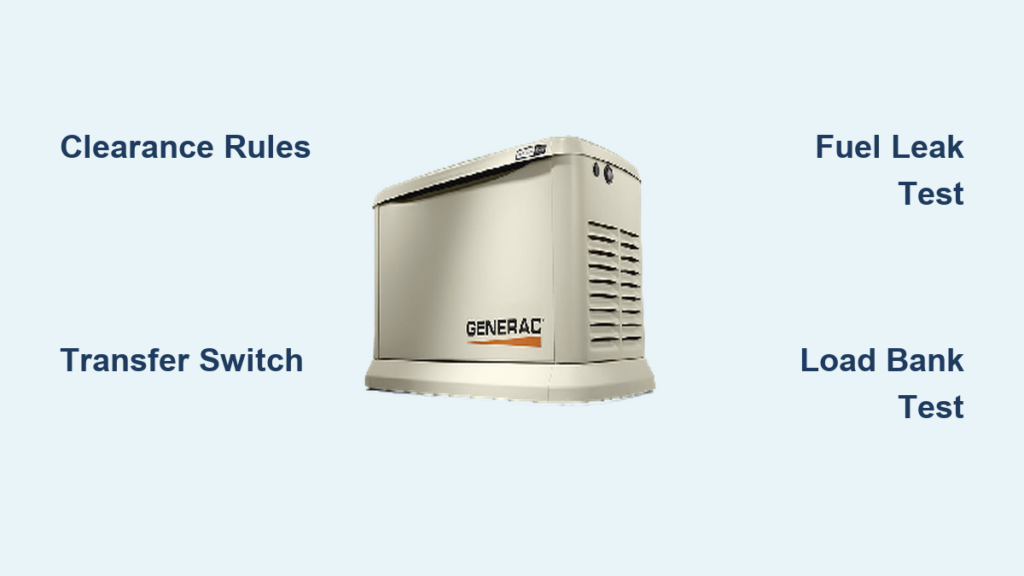
Deadly CO infiltration causes 50% of generator-related fatalities—placement isn’t optional. Install units minimum 5 feet from all windows, doors, and air intakes, with 10+ feet clearance from combustible materials per NFPA 37. Rooftop installations require structural engineers to verify load capacity for the generator’s weight plus 2x vibration forces during operation.
Wind patterns dictate exhaust direction—never position units where prevailing breezes could blow exhaust toward building openings. For downtown banks with limited yard space, technicians often use acoustic enclosures with extended exhaust stacks to meet clearance requirements while containing noise. Always confirm local fire marshal rules; some cities prohibit installations within 3 feet of property lines.
Pass Building Inspections With Pre-Installation Checks
Skip these code requirements and your installation fails inspection:
– Concrete pads: 6-inch thickness with rebar reinforcement on compacted gravel base
– Noise compliance: Generators must operate below 70 decibels at property lines (often requiring sound-attenuating barriers)
– Fuel containment: Diesel tanks need 110% secondary containment with leak detection
– Electrical access: Disconnect switches must be visible from the generator within 50 feet
Technicians verify utility easements before installation—many outages occur because generators were placed over underground gas lines. For historic buildings, check municipal ordinances requiring concealed installations that preserve architectural integrity.
Integrate Electrical Systems Without Causing Backfeed Hazards
Install Transfer Switches That Prevent Electrocution Risks
The transfer switch is your generator’s lifeline—and improper installation risks killing utility workers during grid restoration. Licensed electricians install UL 1008-listed switches rated for 125% of generator output, positioned within sight of the unit per NEC 700.5. This switch automatically isolates your building from the grid within 10 seconds of outage detection.
Critical facilities use switches with load-shedding capabilities that drop non-essential circuits (like decorative lighting) when approaching capacity. Your electrician programs this sequence during installation—hospitals might shed HVAC before life-support equipment. Never use manual transfer switches for commercial applications; they violate NFPA 110 for critical operations.
Wire Panels for Seamless Power Transfers
Electricians route 4/0 gauge cables from the transfer switch to your main panel through rigid metal conduit, sized for 125% of generator amperage. This prevents voltage drop that could crash servers during transfer. The integration includes:
- Surge protection: Metal oxide varistors (MOVs) on all phases to absorb transfer spikes
- Cool-down timers: 10-minute delay before shutdown to prevent engine damage
- UPS coordination: Battery systems stay online while generator reaches operating speed
For facilities with multiple generators, paralleling switchgear synchronizes outputs to handle loads exceeding 2,000kW. Technicians verify phase rotation matches utility power to prevent motor burnout during retransfer.
Pass Final Inspections With Pre-Testing Protocols
Execute Mandatory Load Bank Testing
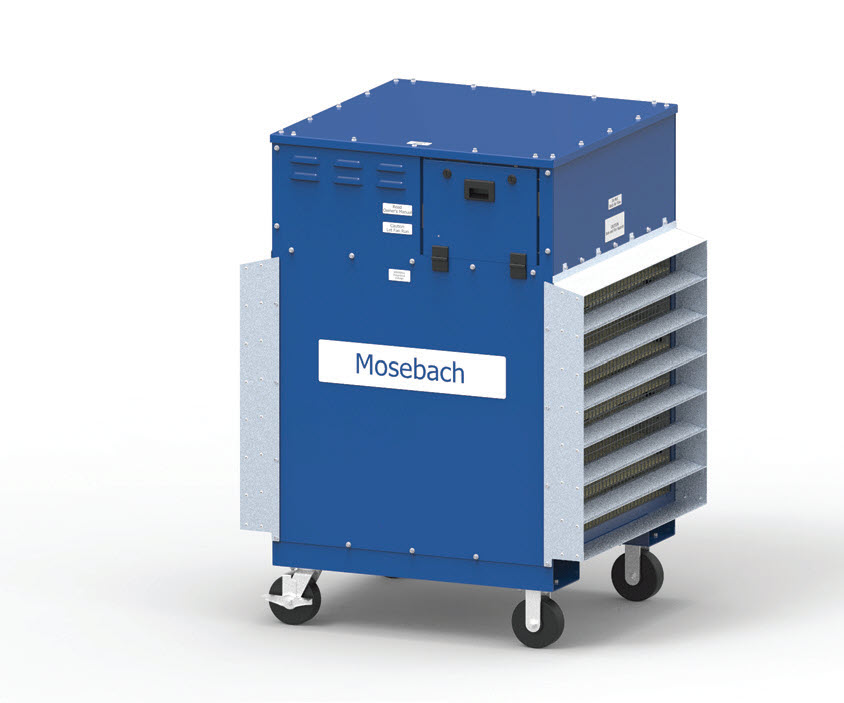
Inspection fails without documented 80% load testing for 2+ hours. Technicians use portable load banks to simulate real-world demand, monitoring:
- Voltage stability (must stay within ±5% of rated voltage)
- Frequency regulation (±0.5Hz tolerance)
- Exhaust temperatures (over 1,000°F indicates wet stacking)
During this test, they verify safety shutdowns activate at precise thresholds—low oil pressure at 25 PSI, high coolant temperature at 220°F. For data centers, harmonic distortion must stay below 5% to protect servers. Skipping this step risks “dry runs” where generators pass idle tests but fail under actual load.
Document Every Safety System for Code Approval
Inspectors will reject installations missing these elements:
– Emergency stop buttons within 6 feet of the unit with protective covers
– CO detectors wired to automatic shutdown within 15 feet of air intakes
– Fire suppression nozzles directed at engine compartments
– Weatherproof labels showing model, kW rating, and fuel type
Technicians photograph all clearances and submit as-built drawings showing conduit routes and disconnect locations. For rooftop units, they provide structural engineer certification of roof loading capacity.
Prevent Costly Failures With Proactive Maintenance
Stop Battery Failures Before Outages Strike
Battery issues cause 80% of generator startup failures. Commercial systems require:
– Dual-battery setups with automatic load sharing
– Trickle chargers maintaining 13.2–13.8V at all times
– Quarterly specific gravity tests for flooded batteries
Replace batteries every 36 months regardless of performance—age weakens cranking power. During monthly tests, verify voltage doesn’t drop below 11.5V while cranking. Clean corrosion from terminals with baking soda solution immediately to prevent connection failure.
Eliminate Wet Stacking Through Proper Loading
Unburned fuel clogging exhaust systems (wet stacking) occurs when generators run below 30% load for extended periods. Prevent this by:
– Scheduling monthly 30-minute tests at 75%+ capacity
– Installing load banks for facilities with minimal critical loads
– Using fuel stabilizers for diesel units running infrequently
During annual service, technicians inspect for black exhaust residue and oily deposits in mufflers—early wet stacking signs requiring immediate load testing.
Verify Installer Credentials Before Signing Contracts
Demand These Non-Negotiable Certifications
Reject contractors without:
– State electrical license with commercial generator endorsement
– Manufacturer-specific training (Cummins, Kohler, or Generac certification)
– $2M+ general liability insurance covering installation errors
– Background-checked technicians for facilities handling sensitive data
Ask for proof of NFPA 110 compliance training—this standard governs installation of emergency power systems. Certified technicians carry digital copies of their credentials; verify them through state licensing boards.
Confirm 24/7 Emergency Response Capabilities
Your installer must provide:
– Remote monitoring with SMS outage alerts
– 4-hour response guarantee for critical facilities
– On-call technicians with generator-specific diagnostic tools
– Fuel supply partnerships for extended outages
Ask for written response time guarantees in your contract. During Hurricane Ida, certified providers maintained 95% uptime for hospitals through coordinated fuel deliveries—unqualified contractors left facilities dark for days.
Your Business Can’t Afford Generator Failure. Every minute of downtime during an outage costs commercial facilities an average of $5,600—while a properly installed generator pays for itself in under 18 months through avoided losses. By following this commercial generator installation checklist, you’ll ensure seamless power transitions that protect revenue, safety, and reputation when the grid fails. Schedule your professional load assessment today to lock in operational continuity—before the next storm hits.