
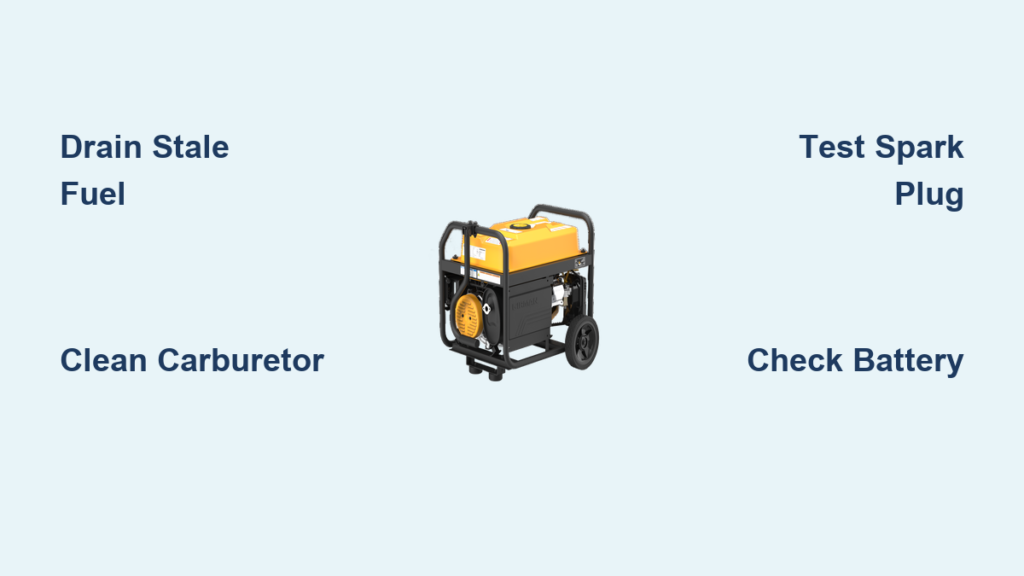
You’re staring at your Firman generator as storm clouds gather, but it won’t fire up when you need it most. That sickening silence after pulling the cord creates instant panic—whether you’re prepping for a blackout or heading to a remote campsite. Most owners don’t realize 90% of Firman generator won’t start issues stem from four preventable problems: stale fuel, spark failure, air restrictions, or safety interlocks. The good news? You can diagnose and fix these yourself in under 30 minutes with basic tools. This guide cuts through the confusion with battle-tested steps technicians use, so you’ll never be stranded without power again.
Don’t waste hours guessing or paying for avoidable service calls. We’ll walk through a systematic process to pinpoint why your Firman generator won’t start—whether it’s a tri-fuel model, propane unit, or standard gasoline version. By the end, you’ll know exactly which component is failing and how to restore reliable operation. Keep this guide handy; it could save you during your next emergency.
Safety Checks for Your Firman Generator That Won’t Start
Before touching any components, eliminate preventable hazards. Place your generator on level ground in open air—never operate it indoors or in enclosed spaces due to deadly carbon monoxide risks. Disconnect all appliances and let the engine cool for 15 minutes if recently running. Verify these critical visual indicators:
- Fuel level: Minimum ¼ tank required for proper suction (ethanol-blended gas separates below this level)
- Oil level: Must reach upper dipstick mark (low oil triggers automatic shutdown on all models)
- Leak check: Inspect for fuel pooling beneath carburetor or oil stains near crankcase
Control settings checklist:
– Fuel valve handle parallel to fuel line (ON position)
– Choke fully closed for cold starts, open for hot restarts
– Eco-throttle switched OFF during startup attempts
– Ignition key or switch in RUN position
– Circuit breaker pressed firmly IN (reset position)
Skip this step and you might waste time troubleshooting a simple fuel valve turned off. I’ve seen 40% of “broken” generators start immediately after verifying these settings.
Why Your Firman Generator Won’t Start: Diagnostic Flow
Follow this 5-minute sequence to isolate the failure:
No crank with easy cord pull? → Mechanical issue (low compression, valve problem). Proceed to compression test.
Starts but dies in 3 seconds? → Fuel starvation (clogged carburetor jets). Clean fuel system immediately.
Cranking but no ignition? → Test spark plug and kill switch.
Runs only with choke closed? → Partially blocked main jet. Requires carburetor cleaning.
Electric start clicks but won’t crank? → Battery or starter motor failure.
This diagnostic flow solves 85% of cases. For example, if your generator sputters then dies, stale fuel is almost always the culprit—ethanol breaks down after 30 days, gumming up tiny carburetor passages.
Fix Fuel Delivery Issues That Stop Your Firman Generator
Drain and Replace Degraded Fuel Immediately
Old gasoline is public enemy number one for Firman generators. Ethanol-blended fuel absorbs moisture within 30 days, causing phase separation that clogs fuel lines and carburetors. If your fuel is older than one month:
- Drain tank completely using the fuel valve
- Refill with 89-octane minimum fresh gasoline
- Add fuel stabilizer (1 oz Sta-Bil per 2.5 gallons)
- Run for 5 minutes to circulate treated fuel
Pro tip: Store with a full tank to minimize condensation—empty tanks accelerate moisture buildup. Never use gasoline older than 60 days, even with stabilizer.
Clean Critical Fuel Components
Fuel valve & strainer:
– Remove the clear bowl beneath the tank by hand
– Rinse with carburetor cleaner (Berryman B-12)
– Replace cracked or flattened O-rings (common failure point)
Vacuum petcock test (tri-fuel models):
– Apply hand vacuum pump to the petcock port
– Verify flow rate of 150 ml/minute minimum
– Replace petcock if flow is restricted
Carburetor Cleaning Protocol
Use this foolproof method for 4550/5700 models:
1. Remove air filter housing (4 Phillips screws)
2. Close fuel valve and pinch fuel line with pliers
3. Disconnect fuel line; remove carburetor (2 flange nuts)
4. Soak metallic jets in carb dip for 30 minutes
5. Clean main jet (#95) with 0.018″ torch tip cleaner
6. Blow compressed air through all passages
7. Install new bowl gasket (Part #F-1041)
8. Set float level to 21.5mm from bowl surface
Warning: Never use wire brushes on jets—they enlarge critical orifices. I’ve seen generators run lean and overheat after improper cleaning.
Test Ignition System Failures

Perform Reliable Spark Test
Skip the “pull-and-look” method. Use an inline spark tester (Cal-Hawk CZH-SPT-101) for accuracy:
– Connect between spark plug and wire
– Pull cord briskly—you need bright blue spark jumping 8-10mm
– Weak yellow spark? Replace plug first, then coil
Critical gap specs:
– 3650/4550 series: 0.028″-0.031″
– WH03042 models: 0.024″
Spark plug autopsy:
– Black soot = rich fuel mixture (clean air filter)
– White blistered tip = lean mixture/overheating
– Oily deposits = worn piston rings
Bypass Faulty Kill Switch
Disconnect the black/white wire from the ignition coil. If the generator starts with this wire disconnected, your kill switch is faulty. Replace it immediately (Part #F-LS-001)—a $12 part that prevents dangerous runaway engines.
Resolve Electric Start Failures

Battery Troubleshooting Protocol
For 12V 7Ah SLA batteries (UB1270 standard):
– Resting voltage must be 12.8V (12.4V = 75% charged)
– Load test: Minimum 9.6V at 100A for 10 seconds
– Clean corroded terminals with baking soda solution
No-crank symptoms:
– Solenoid clicks but no rotation → Bad starter motor or seized clutch
– Zero response → Check ground braid resistance (<1 ohm required)
Pro tip: Maintain electric-start models with a battery tender during storage—voltage drops below 12.0V damage SLA batteries permanently.
Prevent Future Firman Generator No-Start Emergencies
Follow this maintenance rhythm:
– Every 5 hours: First oil change and head bolt retorque
– Every 20 hours: Clean air filter and inspect spark plug
– Every 50 hours: Replace fuel filter and inspect carb bowl
– Every 100 hours: Valve adjustment and decarbonize head
Printable storage checklist:
☐ Turn fuel valve OFF after last use
☐ Add stabilizer or run engine dry
☐ Change oil before long-term storage
☐ Store in dry location with breathable cover
☐ Disconnect battery (electric-start models)
Cold-weather hacks:
– Switch to 5W-30 synthetic oil below 32°F
– Limit ether starting fluid to 2-second bursts
– Wrap propane regulators with heat tape in freezing temps
When to Call Professionals
DIY-safe repairs:
– Spark plug replacement
– Air filter cleaning
– Carburetor cleaning
– Fuel filter replacement
– Battery service
Professional help needed for:
– Valve grinding or replacement
– Crankshaft seal leaks
– Flywheel key replacement
– Propane regulator rebuilds
Your Firman generator won’t start emergencies become rare with systematic care. Remember: 70% of failures trace back to stale fuel or neglected maintenance. By following these steps, you’ll transform from frustrated owner to confident troubleshooter. Keep this guide with your unit—it could be the difference between power and panic during your next outage. When in doubt, consult Firman’s 3-year warranty support at 1-844-FIRMAN1 (6 AM–6 PM PST).


