
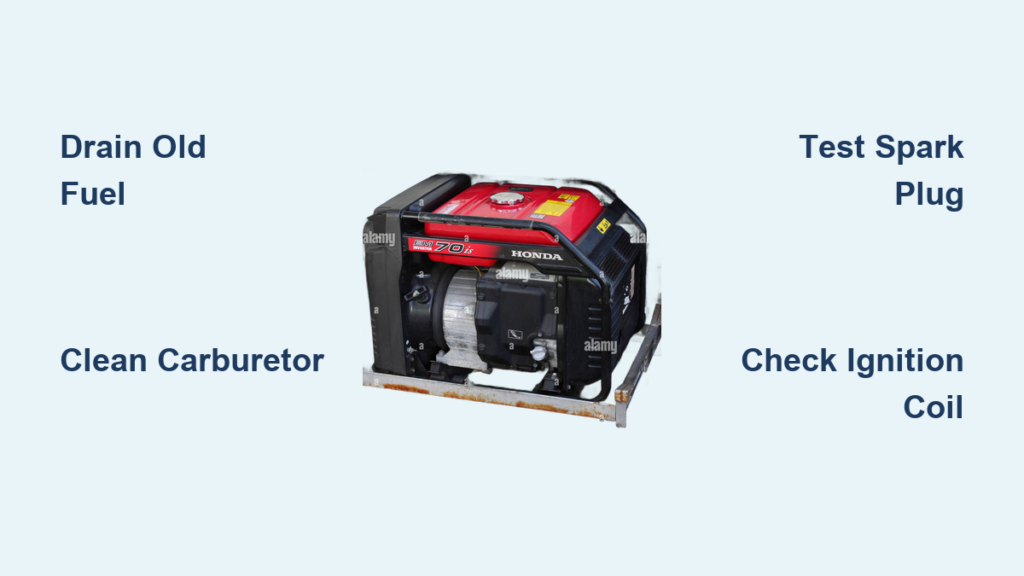
Your Honda generator refuses to start just when you need it most—during a power outage or weekend camping trip. That familiar silence where there should be a steady hum creates immediate frustration. The good news is most Honda generators that won’t start suffer from preventable issues rather than catastrophic failure. With systematic troubleshooting, you can diagnose and fix the problem yourself in most cases, saving hundreds on unnecessary service calls.
Honda generators are known for reliability, but even these precision machines struggle when fuel degrades, components wear, or maintenance gets overlooked. This guide delivers the exact diagnostic steps Honda technicians use to revive “dead” generators. You’ll learn to pinpoint whether your problem stems from fuel system failure, ignition issues, or mechanical faults—and apply proven fixes that get your generator running again, often within 30 minutes.
Fuel System Problems First
Empty the Tank Completely
Old gasoline transforms into a gummy residue that chokes your Honda generator’s delicate fuel pathways. If your generator sat unused for more than 30 days, assume contaminated fuel is your primary culprit. Never attempt to restart with old fuel—the resulting damage costs far more than proper fuel management.
Critical safety action: Drain all fuel from both the tank and carburetor bowl before proceeding. Work on level ground and never tip your generator sideways, as this forces oil into the combustion chamber and air filter, creating secondary problems that complicate diagnosis.
Clean Fuel Contamination Signs
Look for these unmistakable indicators of fuel system failure:
– Darkened, cloudy appearance in remaining fuel
– Strong varnish-like odor when removing the fuel cap
– Visible sediment or particles floating in the tank
– Sticky residue inside the carburetor bowl when drained
When draining the carburetor, use a clear container to examine the fuel quality. If you see anything other than clean, clear gasoline, your carburetor jets are almost certainly clogged and require thorough cleaning.
Spark Plug Testing Made Simple
Quick Visual Inspection
Remove your Honda generator’s spark plug using the proper socket from your tool kit. Examine these critical elements under bright light:
- Cracked porcelain insulator = immediate replacement required
- Black, sooty deposits = rich fuel mixture or oil burning
- White, blistered electrode = overheating or lean fuel mixture
- Wet with fuel = flooding or ignition system failure
A healthy spark plug shows light tan deposits on the electrode and insulator tip—evidence of proper combustion.
Test Spark Without Special Tools
Reattach the spark plug wire to the plug and ground the metal base firmly against the engine block. Pull the starter rope while watching for a strong blue spark jumping the electrode gap. No spark or a weak yellow spark indicates ignition system failure requiring further diagnosis.
Pro tip: Perform this test in daylight—many weak sparks appear adequate in dim light but lack sufficient voltage to ignite the fuel mixture under compression.
Carburetor Cleaning Process

Determine If Cleaning Will Work
Before disassembling your carburetor, try this quick field test: Spray carburetor cleaner directly into the carburetor throat while pulling the starter rope. If the engine fires momentarily then dies, you’ve confirmed a clogged carburetor as the problem—cleaning will likely restore operation.
Deep Clean When Necessary
For stubborn clogs that resist quick cleaning:
1. Remove the carburetor bowl and float assembly
2. Soak metal components (excluding rubber gaskets) in carburetor cleaner for 15 minutes
3. Use compressed air to thoroughly clear all fuel passages
4. Replace all gaskets and O-rings with new ones
Warning: Never use wire or metal tools to clear carburetor jets—this enlarges the precisely calibrated openings, creating permanent performance issues. Always use carburetor cleaner spray or specialized plastic cleaning tools.
Ignition Coil Failure Patterns
Coil Testing Sequence
Honda ignition coils typically fail gradually rather than completely. Test systematically to confirm failure:
- Verify spark plug functionality by testing in another engine or with a spark tester
- Check coil resistance with a multimeter (consult your model’s service manual for specifications)
- Inspect coil housing for cracks, burns, or melted areas
Expert insight: Ignition coils often fail when hot then work again when cooled. Test immediately after your generator stops running for the most accurate diagnosis—waiting until it cools may give false “good” results.
Recoil Starter Repair
Diagnose Starter Engagement
Remove the starter housing cover and watch the mechanism while pulling the rope. The engagement tabs must:
– Snap outward forcefully to grip the flywheel
– Retract smoothly when rope is released
– Show no visible wear on contact surfaces
– Allow full rope rewind without binding
A malfunctioning recoil system creates the illusion of engine failure when the problem is actually mechanical disengagement.
Common Starter Fixes
Address these frequent recoil problems:
– Rope won’t retract: Replace the recoil spring (a $10 part requiring 15 minutes)
– Dogs won’t engage: Clean pivot points with degreaser and apply light lubricant
– Complete failure: Install a new recoil assembly (under $40 for most Honda models)
Time-saving tip: Before disassembling, spray penetrating oil around the recoil housing and let it sit for 10 minutes—this often frees sticky components without full disassembly.
Electrical Switch Testing
Multimeter Continuity Tests
All Honda generator switches follow the same testing protocol:
Testing procedure:
1. Disconnect switch wires from the control panel
2. Set multimeter to continuity mode (beep setting)
3. Test switch in both ON and OFF positions
4. OFF position: Should show no continuity (open circuit)
5. ON position: Should show continuity (closed circuit)
Quick field test: Temporarily bridge the switch terminals with a paperclip. If the generator starts immediately, you’ve confirmed a faulty switch requiring replacement.
Flywheel Key Diagnosis

Why Keys Shear
The flywheel key acts as a mechanical fuse—it’s designed to break during sudden engine stoppage to prevent costly internal damage. Common causes include:
– Blade strike on generator/welder models
– Engine seizure from oil starvation
– Severe backfire during starting attempts
A sheared key throws engine timing off completely, preventing startup despite other systems functioning properly.
Inspection Without Special Tools
Remove the flywheel nut and carefully lift off the flywheel. The key should be a single, solid piece of metal spanning the crankshaft groove. If you see two separate pieces or obvious damage, replacement is mandatory—your generator cannot run with a broken flywheel key.
Troubleshooting Decision Tree

Start With Fuel System
Symptoms: Engine cranks strongly but won’t fire
1. Verify fresh fuel (less than 30 days old)
2. Confirm fuel valve is open
3. Check spark plug for wetness (indicates fuel delivery)
4. If plug is dry, clean carburetor thoroughly
Check Ignition Next
Symptoms: Engine cranks, plug is wet, no start
1. Test spark plug directly on engine block
2. Replace plug if weak or no spark appears
3. Test ignition coil if new plug doesn’t solve issue
4. Inspect flywheel key if timing seems off
Evaluate Starting System Last
Symptoms: Engine won’t crank or cranks weakly
1. Verify recoil starter engagement
2. Check oil level (low oil prevents starting on safety models)
3. Test all electrical switches for continuity
4. Assess for engine seizure (attempt to turn flywheel by hand)
Prevention Strategies That Work
Monthly Maintenance Routine
Even stored generators need attention:
– Run for 15 minutes monthly under light electrical load
– Add fuel stabilizer to fresh gasoline before storage
– Check oil level before each use and change annually
– Exercise recoil starter monthly to prevent sticking
Critical tip: Always run your generator dry before extended storage—leave the fuel valve open with the engine running until it stops. This clears fuel from the carburetor, preventing clogs during storage.
When Professional Help Makes Sense
DIY vs Professional Repair
Fix these yourself:
– Fuel system cleaning and stabilization
– Spark plug replacement and testing
– Basic carburetor cleaning and rebuild
– Switch testing and replacement
Call a pro for:
– Internal engine repairs
– Electrical system rewiring
– Carburetor replacement on newer EFI models
– Warranty-covered repairs (to avoid voiding coverage)
Most Honda generators that “won’t start” simply need fresh fuel and a clean spark plug. Start with the basics before assuming major failure—your generator likely just needs the right combination of clean fuel, strong spark, and proper maintenance to roar back to life. With these proven diagnostic steps, you’ll transform from frustrated owner to confident generator technician, ready to tackle any starting problem with precision.


