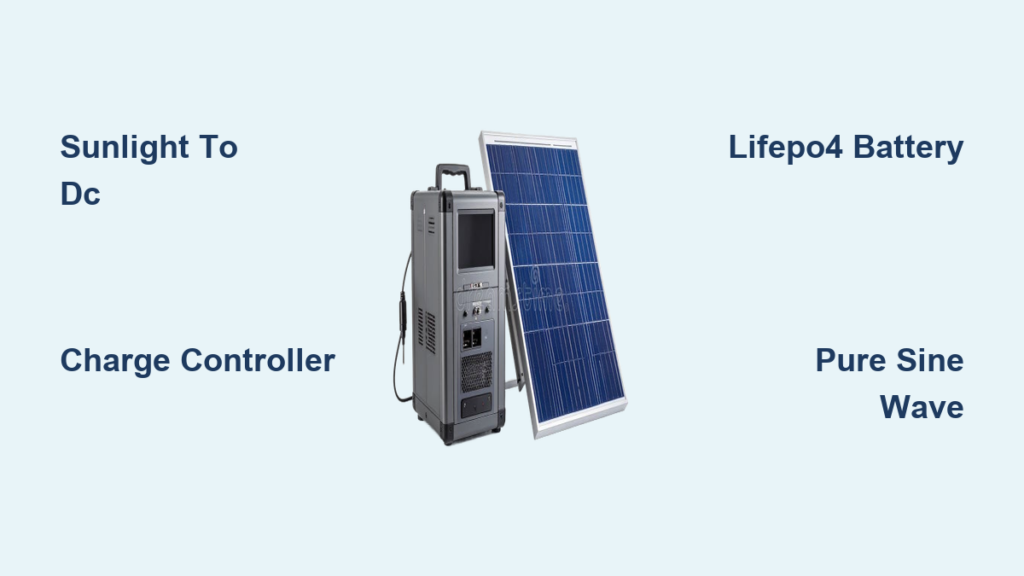
You’re stranded during a blackout with a dying phone, or you’re deep in the wilderness needing to run a CPAP machine. Suddenly, a compact unit silently powers your essentials using nothing but sunlight—no fumes, no noise. This is the reality of modern solar generators, and understanding how a solar generator works unlocks the key to reliable off-grid power. Unlike gas-powered models that burn fuel, these systems convert sunlight into stored electricity through a seamless four-stage process. By the end of this guide, you’ll know exactly how each component transforms photons into usable AC power for your refrigerator, laptop, or medical device—plus critical insights to choose and maintain your system.
Solar Energy Capture Process
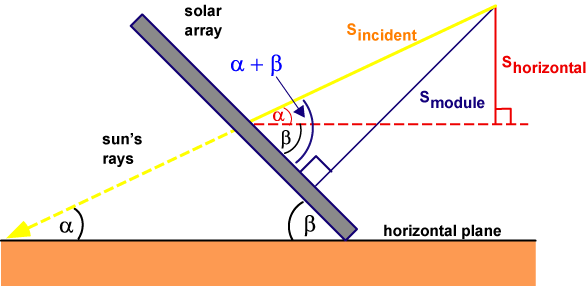
Sunlight becomes electricity the moment photons strike your photovoltaic (PV) panels. These panels contain silicon layers that release electrons when hit by light, generating direct current (DC) electricity. But not all sunlight delivers equal power—your panel’s output depends on four critical factors:
- Sun angle: Panels perpendicular to the sun’s rays produce maximum wattage (up to 25% more than tilted surfaces)
- Shading: Even 10% panel coverage can slash output by 50% due to cell interconnection
- Temperature: Efficiency drops 0.3-0.5% per °C above 25°C—cool, sunny days outperform hot ones
- Irradiance: Brightness intensity directly impacts wattage (e.g., 1,000W/m² on clear days vs. 300W/m² under clouds)
Portable panels range from 60W for backpacking to 400W for home backup. Bifacial models like EcoFlow’s PV220W capture reflected light from both sides, boosting yield by 25% on snowy or sandy terrain. For faster recharging, wire multiple panels in parallel (increasing current) or series (increasing voltage)—just ensure your charge controller supports the combined input.
Battery Storage and Regulation
Charge Controller Function
Raw solar power would destroy your battery without regulation. The charge controller acts as a precision traffic cop, preventing overcharging and thermal runaway. Two types dominate the market:
MPPT controllers constantly adjust voltage to harvest 20-30% more energy during cloudy conditions or partial shading. Essential for systems over 150W, they track the “sweet spot” where panels deliver maximum power.
PWM controllers use simple on/off switching, making them 10-15% cheaper but less efficient. Ideal for small 50-150W setups with consistent sunlight, like powering LED lights on a weekend camping trip.
Always verify your controller’s max input voltage (Voc) matches your panel configuration—exceeding this can fry the unit.
Battery Chemistry Comparison
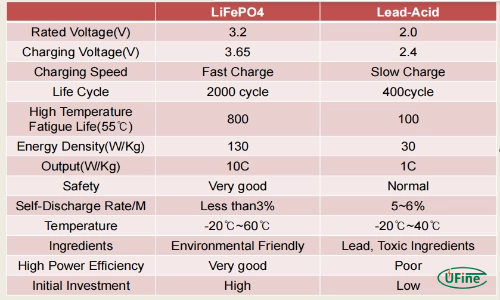
Your solar generator’s battery bank determines longevity, safety, and real-world usability. Here’s how top chemistries perform:
| Chemistry | Real-World Lifespan | Depth of Discharge | Weight per kWh | Critical Limitation |
|---|---|---|---|---|
| LiFePO4 | 3,000-6,000 cycles | 90-100% | 25-30 lbs | Rare but expensive replacement |
| NMC Lithium | 2,000-3,500 cycles | 80-90% | 20-25 lbs | Thermal runaway risk if damaged |
| Lead-Acid | 200-500 cycles | ≤50% | 60-70 lbs | Sulfation in storage; weekly maintenance |
Modern systems use LiFePO4 for its safety and 10-year lifespan. Every battery includes a Battery Management System (BMS) that shuts down the unit if temperatures exceed 60°C or cell voltages imbalance—preventing fires during critical loads like refrigerator operation.
Power Conversion and Distribution
Inverter Operation
Your stored DC electricity must become standard 120V AC to power household devices. The inverter handles this conversion, but its specifications dictate what you can run:
- Continuous wattage (e.g., 1,800W on EcoFlow Delta 2) determines sustained loads like refrigerators
- Surge capacity (typically 2x continuous) handles startup spikes—crucial for fridge compressors needing 3x running wattage
- Pure sine wave output is non-negotiable for medical devices and variable-speed tools; modified sine wave damages sensitive electronics
A 2,000W inverter can run a 1,500W space heater but cannot start a 3,000W central AC unit—even if the AC runs at 2,500W continuously. Always size your inverter for surge demands, not just running wattage.
Output Options
Modern units offer six connection types:
– AC outlets (standard 120V) for laptops and kitchen appliances
– 12V car ports for car fridges or tire inflators
– USB-C PD ports (up to 100W) for fast laptop charging
– DC5521 barrel jacks for specialized gear like ham radios
– Anderson Powerpole ports for chaining external batteries
– Wireless charging pads (premium models) for phones
Real-time displays show critical data: state of charge (SOC), input/output watts, and estimated runtime—no guesswork when powering life-saving CPAP machines.
Real-World Performance Examples

Runtime Calculations
Battery capacity (Wh) divided by device wattage equals theoretical runtime—but real-world factors cut this by 20-30%. Here’s what actually works:
- 400W refrigerator: 2,000Wh battery = 5 hours continuous, but 12-14 hours with cycling (compressor runs 40% of time)
- 40W CPAP machine: 500Wh battery = 10-12 hours (perfect for overnight use)
- 1,000W microwave: 1,024Wh EcoFlow Delta 2 = 45 minutes (15 mins/day for 3 meals)
- Complete home backup: EcoFlow Delta Pro 3.6kWh + four 400W panels powers fridge, lights, and router for 36 hours during outages
Pro Tip: Multiply daily device watt-hours by 1.5 when sizing batteries—this covers cloudy days and inverter inefficiency.
Power Limitations
Solar generators have hard boundaries:
– Cloudy days reduce solar input by 30-70%, extending recharge time from 5 to 15+ hours
– Winter sun angles cut panel yield by 40% compared to summer (critical for northern climates)
– Motor startups require 3-5x running wattage—a 1,500W inverter can’t start a 1,800W well pump
For whole-home backup, you’ll need grid-tied solar + stationary batteries (like Tesla Powerwall), not portable units.
Maintenance and Longevity
Care Requirements
Maximize your system’s 10-15 year lifespan with three simple habits:
– Monthly: Rinse panels with water (no abrasives) to remove dust—dirty panels lose 15% output
– Storage: Keep at 30-80% charge in temperatures between 15-25°C (extreme cold/heat degrades batteries)
– Firmware: Install app updates quarterly—they optimize MPPT tracking and BMS thresholds
Never store lithium units fully charged or empty; both accelerate capacity loss.
Safety Features
LiFePO4 batteries withstand punctures and 300°C temperatures before thermal runaway—unlike NMC lithium. Integrated safety layers include:
– Cell balancing to prevent weak cells from failing
– Short-circuit shutdown within 0.1 seconds
– Over-temperature cutoff at 60°C
– Reverse polarity protection on solar inputs
Premium units like Anker 767 include 5-year warranties covering fire damage—proof of manufacturer confidence.
Cost vs. Performance Analysis
Investment Breakdown
2024 pricing balances capability and value:
– $500-$600: 300Wh/300W camping kit (Jackery Explorer 300 + 100W panel)
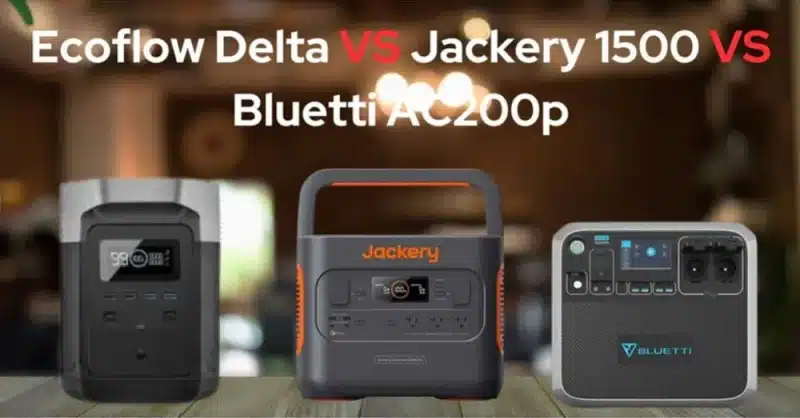
– $1,100-$1,400: 1,000Wh/1,000W emergency kit (EcoFlow Delta 2 Lite + 220W panel)
– $1,700-$2,200: 2,000Wh/2,000W home backup starter (BLUETTI AC200P + 400W panel)
– $3,500+: Expandable 3-6kWh systems (EcoFlow Delta Pro + extra batteries)
Entry models use NMC lithium; mid-range and above feature LiFePO4 for longevity.
Operating Economics
Solar generators cost $0 to run after purchase—no fuel, oil, or filters. Compare this to gas generators burning $0.60/kWh:
– A 2,000Wh system powers 200 kWh over its life → $120 saved vs. gas
– Eliminating annual $150 maintenance saves $1,500 over 10 years
– No carbon monoxide detectors or fuel stabilizers needed
The break-even point hits at 3-5 years for frequent users—making solar the cheaper long-term investment.
Sizing Your Perfect System
Decision Framework
Avoid costly under/oversizing with this 5-step process:
1. List critical loads: Sum wattage × hours used daily (e.g., fridge 400W × 8h = 3,200Wh)
2. Add 50% buffer: 3,200Wh × 1.5 = 4,800Wh battery target for weather fluctuations
3. Match solar input: 4,800Wh battery needs 480W+ panels for full daily recharge (1W panel per 1Wh battery)
4. Verify inverter headroom: Total surge wattage must exceed peak load by 20%
5. Check port counts: Ensure enough AC outlets for simultaneous device use
Common Mistakes
First-time buyers often:
– Ignore surge wattage (e.g., buying 1,000W inverter for 900W fridge that needs 2,700W startup)
– Underestimate winter sun (requiring 2x panels in Chicago vs. Phoenix)
– Overlook expansion (some brands lock you into proprietary batteries)
– Count only AC outlets (missing critical USB-C ports for modern devices)
Always test your system with actual loads before emergencies strike.
Understanding how a solar generator works reveals why it’s the ultimate silent power partner: sunlight becomes DC electricity, regulators protect your battery, inverters deliver clean AC power, and smart distribution keeps your devices alive. With zero fuel costs, minimal maintenance, and decade-long lifespans using LiFePO4 technology, these systems pay for themselves while providing peace of mind. Start by calculating your real wattage needs, prioritize pure sine wave output and MPPT controllers, and choose expandable LiFePO4 models—they’ll deliver reliable, emission-free power through blackouts, adventures, and everything in between. Your path to energy independence begins with one sun-powered charge.