Your refrigerator just shut down during a storm, and your phone’s about to die. You’re staring at your generator wondering if it can handle the load—but you never properly calculated what size generator your home actually needs. After major outages, millions discover their backup power falls short when they need it most. Don’t gamble with your family’s comfort and safety—determining the right generator size follows a precise formula that prevents costly mistakes.
This guide delivers the exact process for calculating generator size for home use, step by step. You’ll learn to inventory essential appliances, account for critical starting surges, and apply the safety margin that keeps your system running smoothly during extended blackouts. No guesswork—just actionable calculations that match your specific household needs.
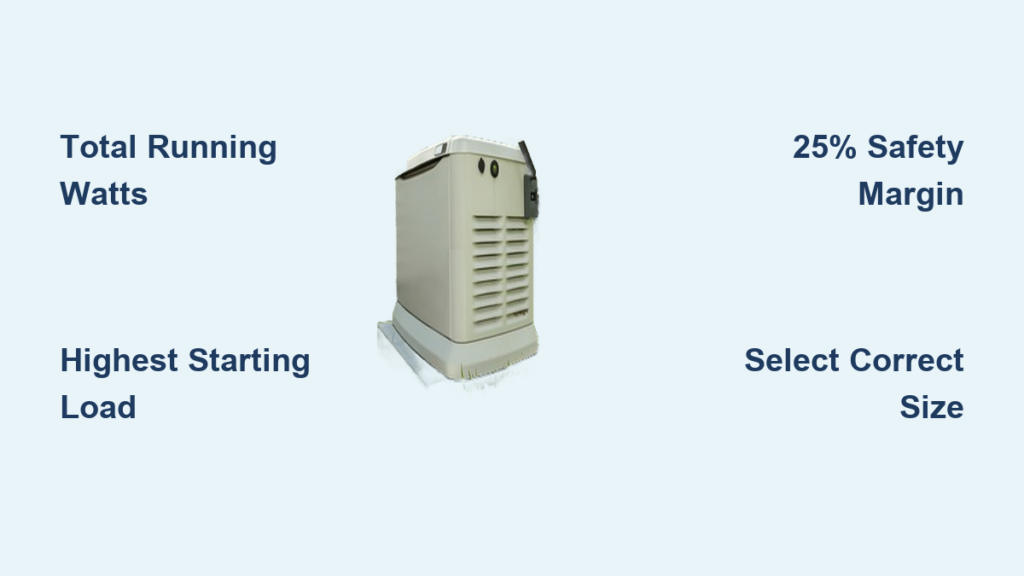
Critical Generator Sizing Rules You Must Follow
Rule 1: Total Running Watts Determines Your Baseline Load
Begin by adding every essential appliance’s continuous operating wattage—this creates your generator’s minimum continuous capacity requirement. Your refrigerator might draw 700 watts constantly, while your furnace blower uses 800 watts. These running watts form the foundation of your calculation, representing the steady power demand your generator must sustain indefinitely.
Pro tip: Don’t overlook small electronics—your Wi-Fi router (5-20 watts), phone chargers (5-25 watts each), and LED lights (8-15 watts per bulb) quickly add up during extended outages. Track every essential item requiring electricity to avoid underestimating your baseline load.
Rule 2: Highest Starting Load Creates Your Peak Demand
Motor-driven appliances surge dramatically during startup—often requiring 2-3 times their running wattage. Your central AC unit might pull 5,000 watts to start before settling at 2,500 watts during operation. This starting wattage creates your most significant sizing challenge, as the generator must handle this brief but intense power spike without shutting down.
Visual cue: When an appliance starts, watch for lights dimming momentarily—this indicates a significant power surge your generator must accommodate. Always identify which single appliance creates the largest starting demand in your home.
Rule 3: Apply the 25% Safety Margin Formula
Combine your total running watts with the highest starting watts figure, then multiply by 1.25. This essential buffer prevents overloads, handles unexpected power demands, and accounts for generator performance degradation over time. For example: (8,500 running watts + 3,500 starting watts) × 1.25 = 15,000 minimum watts.
Warning: Skipping this safety margin risks automatic generator shutdown during critical moments. Your generator might handle the load on paper but fail when real-world conditions add stress to the system.
Step-by-Step Home Generator Calculation Process
Inventory Every Essential Circuit in Your Home
Walk through each room with a notepad and document everything requiring electricity during outages. Include often-forgotten items like well pumps (1,000-2,000 running watts), garage door openers (550-725 watts), and sump pumps (800-1,050 watts). Prioritize medical equipment like CPAP machines (30-60 watts) and refrigeration for medications.
Time estimate: This inventory process takes 20-30 minutes for most homes. Don’t rush—missing one critical appliance can invalidate your entire calculation.
Document Exact Power Requirements for Each Appliance
For every item on your list, find two crucial numbers on the appliance’s data plate or manual:
Running Watts: Continuous power during normal operation
– Refrigerator: 300-800 watts
– Gas furnace: 400-600 watts
– LED lights: 8-15 watts each
Starting Watts: Surge power required at startup
– Central AC (3-ton): 2,500-6,000 watts
– Well pump (1/2 hp): 1,000-2,000 running, 2,000-3,000 starting watts
– Washing machine: 500-1,400 running, 2,300 starting watts
Common mistake: Using manufacturer estimates instead of your specific appliance’s actual ratings. Always check the data plate on your own equipment for accurate figures.
Calculate Your Minimum Generator Size with Precision
- Sum running watts: Add all continuous power requirements from your inventory
- Identify peak starting: Find the single highest starting wattage in your list
- Apply safety formula: (Total running + Highest starting) × 1.25
- Select standard size: Choose the next available generator size above your calculation
Example: If your total running watts equal 3,100 and your highest starting load is 3,500 (central AC), your calculation becomes (3,100 + 3,500) × 1.25 = 8,250 watts. You’d need at least a 9,000-watt generator to meet this demand safely.
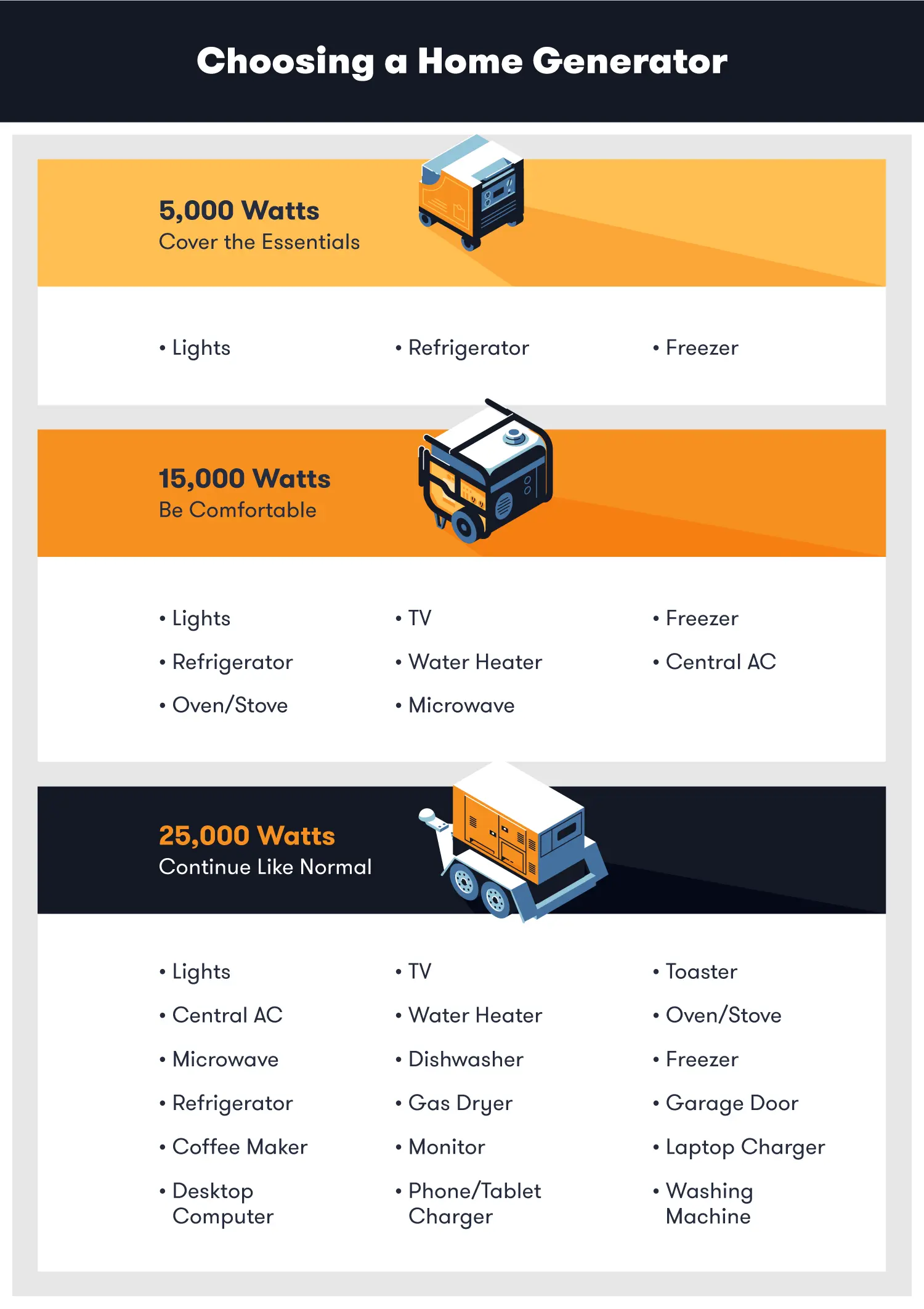
Power Requirements by Appliance Category
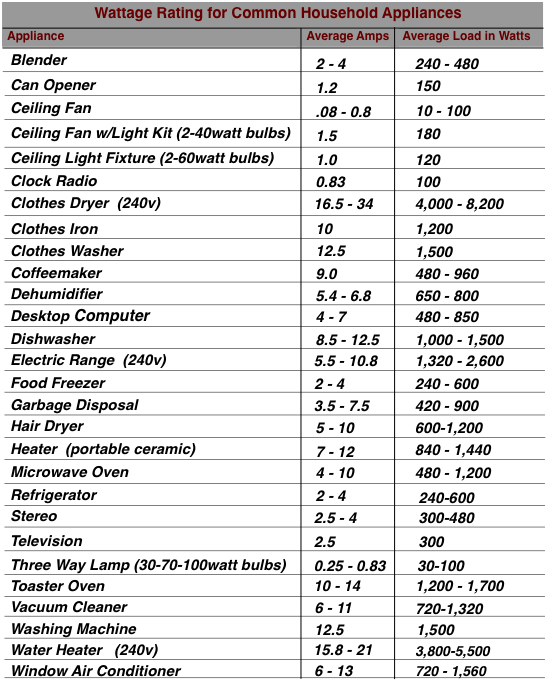
Kitchen and Laundry Essentials
- Electric dryer: 3,000-5,000 running watts (5,500 starting)
- Dishwasher: 1,200-1,500 watts
- Microwave: 700-1,100 watts
- Coffee maker: 600-1,200 watts
- Washing machine: 500-1,400 running, 2,300 starting watts
Pro tip: Gas appliances use minimal electricity—gas ranges need only 120-300 watts for ignition controls, making them significantly easier to power during outages.
HVAC and Water Systems
- Electric furnace: 10,000-50,000 watts (varies by size)
- Central AC (3-ton): 2,500-3,500 running, 5,000-6,000 starting watts
- Electric water heater: 3,000-4,500 watts
- Well pump (1/2 hp): 1,000 running, 2,000 starting watts
Critical note: Electric heating systems create massive generator demands. If you have electric heat, consider alternative heating solutions during outages or prepare for a much larger generator requirement.
Electronics and Comfort Items
- TV (55″ LED): 80-150 watts
- Desktop computer: 200-400 watts
- Wi-Fi router: 5-20 watts
- Space heater: 750-1,500 watts
- CPAP machine: 30-60 watts
Time-saving shortcut: Group similar items together—calculate total lighting load rather than tracking each bulb individually.
Avoid These Critical Generator Sizing Mistakes

Undersizing Risks That Cause System Failure
- Automatic shutdown: Generator cuts power when overloaded, leaving you in the dark
- Appliance damage: Voltage fluctuations harm sensitive electronics and motors
- Inadequate cooling: Can’t run AC during summer outages when you need it most
- Food spoilage: Insufficient power for refrigerators/freezers during extended outages
Real-world consequence: During Hurricane Ida, homeowners with undersized generators watched helplessly as their refrigerators shut down after running for just a few hours.
Oversizing Problems That Waste Your Money
- Fuel waste: Larger generators burn disproportionately more fuel at partial loads
- Higher costs: A 22kW generator costs significantly more than a properly sized 15kW unit
- Maintenance issues: Diesel generators may “wet stack” when run at light loads
- Installation complexity: Requires larger transfer switches and electrical modifications
Expert insight: A generator running consistently below 30% capacity experiences reduced efficiency and potential long-term reliability issues.
Professional Verification and Installation Requirements
Load Analysis That Validates Your Calculation
While your manual calculation provides a solid estimate, a licensed electrician performs actual load testing to verify real-world power consumption. They’ll measure precise starting surges and identify hidden loads you might have missed, ensuring your generator selection matches actual demand.
When to call a pro: If your calculation approaches 10,000 watts or involves complex electrical systems, professional verification becomes essential before purchasing.
Transfer Switch Compatibility Requirements
Your generator size directly determines transfer switch specifications:
– 30-amp switch: Handles up to 7,200 watts (120V/240V)
– 50-amp switch: Handles up to 12,000 watts
– 100-amp switch: Handles up to 24,000 watts
Critical check: Ensure your main electrical panel has sufficient space for the required transfer switch before finalizing your generator size.
Final Generator Sizing Checklist Before Purchase
Pre-Purchase Verification Steps
- Complete inventory: Document every essential appliance with actual power ratings
- Power verification: Check data plates rather than relying on estimates
- Safety margin: Apply the 25% buffer to your calculated needs
- Future needs: Add capacity for planned electrical additions
- Professional assessment: Get installation evaluation before purchase
Pro tip: Photograph each appliance’s data plate for future reference—this saves time if you need to recalculate later.
Your generator calculation isn’t just numbers—it’s your family’s comfort and safety during extended outages. Take time to inventory accurately, calculate precisely, and verify professionally. The right-sized generator runs efficiently, protects your appliances, and provides peace of mind when the grid goes dark. Don’t wait for the next storm to discover you guessed wrong—calculate your home’s generator size correctly today.