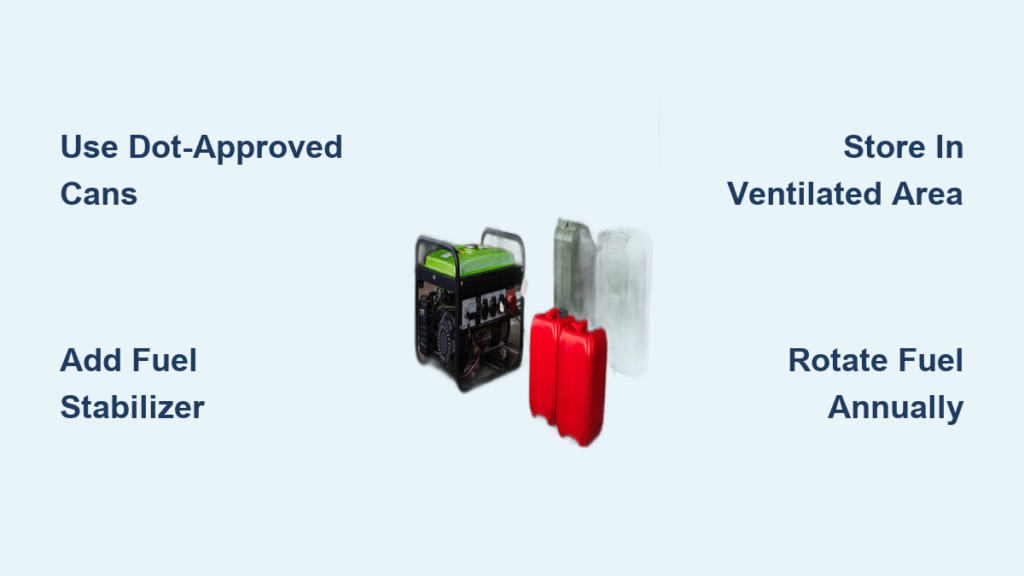
When hurricanes knock out power for days, gas stations vanish within hours as crowds swarm every pump. Your generator’s standard 5-gallon tank won’t keep lights on through a three-day outage—leaving your family in darkness when you need electricity most. Smart homeowners avoid this crisis by building a strategic gasoline reserve before disaster strikes. This isn’t about hoarding; it’s about ensuring your generator runs reliably when the grid fails. You’ll learn exactly how to store 25-30 gallons of gasoline safely—enough for 25+ hours of generator operation—without violating fire codes or creating dangerous hazards.
Most people underestimate how quickly untreated gasoline degrades. Within 60 days, it forms sticky varnish that clogs carburetors and kills generator startup. Worse, improper storage turns your garage into a firebomb waiting to ignite. But with the right containers, stabilizers, and rotation system, you can maintain emergency fuel that works flawlessly when needed. Let’s cut through the guesswork and build your fail-safe gasoline storage plan.
Calculate Your Generator Fuel Requirements

Determine Exact Gallons Needed Per Hour
Track your generator’s consumption during a practice run: most portable units burn 0.75-1 gallon hourly under typical home loads. For a 72-hour outage with conservative 8-hour daily operation, you’ll need 25-30 gallons minimum. Never rely on the generator’s small onboard tank—calculate based on your actual power demands, including refrigerators, medical devices, and well pumps.
Size Containers for Practical Rotation
5-gallon DOT-approved cans offer critical advantages: easy transport to gas stations, safer handling during refueling, and simplified annual rotation. Reserve 25-gallon tanks only for permanent installations in well-ventilated sheds—they reduce lifting strain but require strict adherence to local storage limits. Urban homeowners in areas like South Florida often max out at 25 total gallons due to fire codes, so prioritize portable cans for flexibility.
Account for Thermal Expansion Space
Always leave 5% headspace (about 1 inch below the neck) in every container. Gasoline expands significantly when temperatures rise, increasing vapor pressure dangerously. Ignoring this creates bulging containers and potential leaks—especially critical during summer storm seasons.
Choose Legally Compliant Storage Locations

Eliminate Critical Fire Hazards Immediately
Gasoline vapors travel 25+ feet to find ignition sources. Never store fuel:
– Inside any living space (including basements or garages attached to your home)
– Within 15 feet of pilot lights (water heaters, furnaces, or dryers)
– On concrete floors where static electricity can spark explosions
– In direct sunlight where temperatures exceed 80°F—common in unventilated sheds
Optimize Conditions for Long-Term Safety
Your storage zone must maintain consistent temperatures below 80°F year-round with cross-ventilation through windows or vents. Place containers on wooden shelves 6+ inches off the floor to prevent condensation and static buildup. Position a Class B fire extinguisher within 10 feet—not as a precaution, but as a non-negotiable requirement for handling spills.
Verify Local Quantity Limits First
Contact your fire department before buying containers. Many jurisdictions cap residential gasoline storage at 25 gallons total; coastal cities like Miami enforce stricter limits due to high-density housing risks. Violations risk fines or forced disposal—defeating your emergency planning.
Prevent Fuel Degradation with Proper Stabilization
Apply Stabilizer Correctly During Filling
Gasoline forms carburetor-clogging varnish within 60 days without treatment. For 5-gallon cans: add 2 ounces of Sta-Bil before pouring fuel, then fill to 95% capacity. For 25-gallon tanks: use 10 ounces for one-year storage or 20 ounces for two-year viability. Shake containers vigorously for 60 seconds to ensure thorough mixing—never add stabilizer to already-filled containers.
Implement Foolproof Date Tracking
Label every container with permanent marker showing:
– Fill date (e.g., “04/15/2024”)
– Expiration date (exactly 1 year later)
– Stabilizer type (e.g., “Sta-Bil 360”)
This prevents accidental use of degraded fuel—a single bad batch can destroy your generator’s carburetor.
Execute Safe Refueling Protocols

Mandatory Pre-Refueling Steps
- Shut down the generator completely—never refuel while running
- Wait 30 minutes minimum for engine and exhaust components to cool
- Extinguish all ignition sources within 50 feet (grills, cigarettes, pilot lights)
- Place containers on the ground before opening (never in vehicle trunks)
Avoid Static Electricity Ignition
Use plastic funnels with static-dissipating strips or metal siphon pumps bonded to the generator frame. Pour slowly while maintaining metal-to-metal contact between the container spout and generator tank. If you smell gasoline vapors, stop immediately—vapors ignite more easily than liquid fuel.
Critical Post-Refueling Actions
Wipe all spills with absorbent pads before restarting the generator. Store containers back in your designated storage area within 10 minutes—never leave fuel near the generator overnight. Run the unit for 5 minutes to confirm no leaks developed during refueling.
Maintain Fuel Quality Through Systematic Checks
Monthly Container Inspections
Check for these danger signs:
– Ballooning sides indicating pressure buildup from vapor expansion
– Cloudy fuel or separation layers signaling water contamination
– Leaks around seams or degraded gaskets on caps
– Strong varnish smell replacing normal gasoline odor
Emergency Pressure Relief Procedure
If containers appear pressurized:
1. Move them outdoors to a well-ventilated area away from buildings
2. Loosen caps slowly while pointing away from your body
3. Allow fumes to dissipate for 5 minutes before full opening
4. Inspect vent holes for clogs with a toothpick (never metal tools)
Generator-Specific Storage Prep
After each outage:
– Close the fuel shutoff valve and run the generator dry
– Add 1 ounce of stabilizer directly into the generator’s tank
– Cover the unit with a breathable tarp in a dry location
– Store it separately from your main gasoline reserve
Balance Risks with Practical Preparedness
Conduct Your Personal Risk Assessment
Ask: How often do you experience multi-day outages? Do you have garage space meeting ventilation requirements? Could children accidentally access fuel? If your region averages 1-2 outages yearly, start with 10-15 gallons—never jump straight to 30. Urban dwellers should prioritize dual-fuel generators (propane/natural gas) to bypass gasoline storage entirely.
Implement Progressive Safety Upgrades
Begin with these non-negotiables:
– Fire suppression: Install a $40 flammable liquid storage cabinet
– Spill containment: Place containers on plastic trays holding 110% of capacity
– Family training: Practice emergency shutdowns quarterly
– Code compliance: Get written approval from your fire marshal
Finalize Your Emergency Readiness System
Pre-Storm Season Checklist
96 hours before hurricane landfall:
– Top all containers to 95% capacity using fresh fuel
– Test generators under full household load
– Move containers to elevated ground if flooding threatens
– Confirm stabilizer expiration dates
Annual Fuel Rotation Strategy
Replace stored gasoline every spring:
1. Pour oldest fuel into your car’s tank
2. Drive 50+ miles to fully consume it
3. Refill containers with new gasoline + stabilizer
4. Reset expiration labels immediately
Storing gasoline for generator emergencies demands discipline, not complexity. Start small with 10 gallons in code-compliant containers, master safe refueling protocols, and expand only when your system proves reliable. Remember: degraded fuel or improper storage turns your preparedness asset into a lethal liability. By following these precise steps, you’ll ensure your generator delivers power when it matters most—without risking your family’s safety. Rotate rigorously, inspect monthly, and never compromise on ventilation. Your lights will stay on while others sit in darkness.